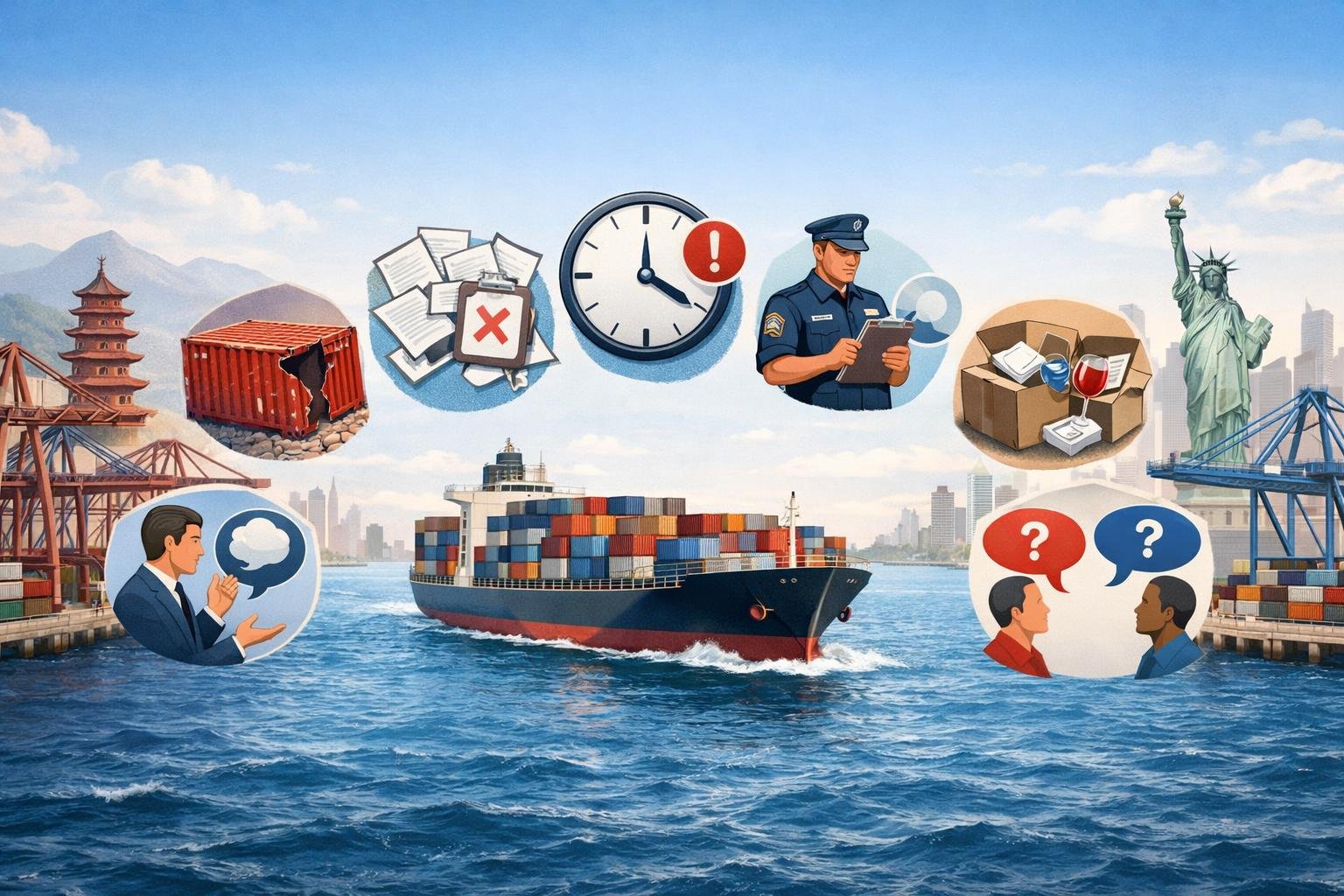
6 Common Mistakes When Shipping from China to USA: Critical Errors That Cost Importers Time and Money
📅 March 19, 2026
6 Common Mistakes When Shipping from China to USA can really trip up even the savviest importers. Shipping products from China to the USA is a tempting way to save money and reach new markets, but it’s not as simple as it looks.
There are so many steps where things can go sideways if you’re not paying attention. Miss a detail, and suddenly you’re losing time and money.
Most importers run into trouble with documentation, customs, supplier checks, packaging, timing, or compliance rules. These common shipping mistakes catch both new and seasoned businesses off guard.
If you know what can go wrong, you’ll have a much better shot at avoiding delays or extra costs. Let’s break down the 6 most frequent mistakes when shipping from China to the USA and what you can do to dodge them.
Inaccurate or incomplete documentation causing customs delays
Documentation errors are behind 30-40% of all customs clearance delays. It’s honestly one of the most frustrating 6 Common Mistakes When Shipping from China to USA.
Missed or incorrect paperwork can stretch delivery times by days or even weeks. Your commercial invoice needs to be spot on—right product descriptions, values, and harmonized system codes.
If these details don’t match your actual shipment, customs will hold your goods. You’ve got to get all required documents in before your shipment arrives.
Incomplete customs clearance documentation is a recipe for delays. Forgetting certificates of origin or packing lists? That’ll stop your shipment at the border.
Even tiny mistakes matter. Typos, wrong phone numbers, or mismatched company names between different forms can trigger extra inspections.
Double-check every document before you send it. Working with experienced freight forwarders makes it way easier to avoid preventable documentation mistakes.
Underestimating shipping and customs fees leading to unexpected costs
It’s shockingly common for businesses to underestimate shipping costs from China. This is one of those 6 Common Mistakes When Shipping from China to USA that can wreck your budget.
Many people assume the freight rate is the whole story, but there’s a lot more to it. The real cost includes customs duties, taxes, port charges, handling, insurance, and paperwork fees.
If you only focus on the base shipping price, you’ll get blindsided by extra charges later. Storage fees add up if your shipment is delayed at the port.
Demurrage charges hit when containers sit too long. VAT and import duties can shift based on your product and its value.
Always ask for a full breakdown of all charges before shipping. Get a total landed cost estimate from your freight forwarder.
Planning for these costs upfront lets you price your products right and protect your margins. Nobody likes surprise bills.
Failing to verify supplier reliability and product quality
This one’s huge. Skipping supplier checks is a classic 6 Common Mistakes When Shipping from China to USA.
Ask for real product samples—not just photos or generic items. Test those samples yourself to make sure they’re up to your standards.
Verify your supplier’s business credentials and certifications. Request their business license, audit reports, and any relevant quality certificates.
If a supplier hesitates to share this info, that’s a red flag. Building a relationship with your supplier through honest communication helps prevent quality issues down the line.
Consider hiring a third-party inspection company to check the factory. They’ll spot recurring issues before you place a big order.
Look up reviews and references from other buyers. It’s the best way to gauge reliability and consistency.
Ignoring proper packaging standards resulting in damaged goods
Poor packaging is one of the most frequent 6 Common Mistakes When Shipping from China to USA. Weak or wrong materials put your products at risk during the long trip.
Pick packaging materials that actually suit your item’s weight and fragility. Shipping heavy stuff in thin boxes or skipping cushioning is just asking for trouble.
Improper packaging means your items might shift inside containers or get crushed in transit. The type of product matters—fragile items need bubble wrap or foam, while heavy goods need reinforced boxes.
Don’t forget about moisture protection, especially for ocean shipments. Condensation can ruin products if you don’t use sealing or desiccants.
Test your packaging before sending large quantities. It’s way better than dealing with costly returns or angry customers later.
Not allowing adequate lead time for shipping and customs clearance
People often underestimate how long shipping from China to the USA actually takes. This is one of those sneaky 6 Common Mistakes When Shipping from China to USA.
Air freight usually takes 5-10 days. Ocean freight? That’s more like 20-40 days. And then you have to add customs clearance time on top.
Customs clearance can take 1-5 days, but delays happen if paperwork needs review or inspections come up. Accurate documentation and some buffer time help you avoid nasty surprises.
Build in extra time for holidays, peak seasons, and random inspections. Start your shipping process early so you don’t miss deadlines or let customers down.
Give yourself at least 1-2 weeks of cushion beyond the expected delivery date. It’s not overkill—it’s just smart planning.
Overlooking import regulations and compliance requirements
Not knowing U.S. import laws is a risky 6 Common Mistakes When Shipping from China to USA. The FDA covers food, cosmetics, and medical devices, while the FCC controls electronics.
Your product might need approval from one or both agencies before it can enter the country. Using the wrong HS codes messes up your duty rates and can lead to penalties.
You’ve got to file your Importer Security Filing (ISF) at least 24 hours before your cargo leaves China. Miss it, and you’re looking at fines up to $5,000 per violation.
Your customs declarations must show accurate product values. If you undervalue goods to save on duties, customs will catch it and hit you with audits and penalties.
Knowing which key shipping mistakes to avoid keeps you compliant and helps you breeze through customs.
How Proper Documentation Prevents Costly Shipping Errors
Getting your paperwork right keeps shipments from getting stuck in customs and saves you from surprise fines. Even one missing or incorrect document can add thousands to your costs.
Common Paperwork Omissions in China-USA Logistics
The commercial invoice is critical, but people often forget things like the buyer’s tax ID or the right tariff codes. Always use full product descriptions—no vague stuff like “parts.”
Your packing list has to match your commercial invoice exactly. If weights or quantities don’t line up, customs will flag your shipment.
Essential documents to include:
- Commercial invoice with complete HS codes
- Packing list with exact measurements
- Bill of lading or air waybill
- Certificate of origin
- Import licenses (if needed for your product)
Skip the certificate of origin and you could lose out on tariff benefits. That can bump your costs by 5-25% depending on your product.
Tips for Double-Checking Customs Declarations
Compare your declared values with recent similar shipments. Customs agents know the usual price ranges, so incorrect documentation triggers holds fast.
Double-check your HS codes with the official Harmonized Tariff Schedule before each shipment. Using outdated codes can lead to penalties for misclassification.
Your pre-shipment checklist:
- Check all amounts are in USD
- Make sure product descriptions match the goods
- Verify weights are consistent across documents
- Confirm HS codes are current and specific
Have someone else review all paperwork before you submit it. Mistakes in documentation lead to delays and fines, so a second set of eyes is worth it.
Understanding Incoterms and Avoiding Miscommunication
Incoterms spell out who pays for shipping and who takes on risk during transport. If you get these terms wrong, you can end up with surprise fees, delays, or arguments with your supplier. Don’t just assume—always clarify the details before you ship.
6 Common Mistakes When Shipping from China to USA: Choosing the Right Incoterm
Let’s talk about the 6 Common Mistakes When Shipping from China to USA. One of the biggest errors? Picking the wrong Incoterm. This happens all the time in international trade. It’s not just a paperwork thing—it can cost you money and time.
If you’re shipping from China to the USA, you need to choose Incoterms that fit your experience and your shipping method. Don’t just guess or copy what someone else did.
FOB (Free on Board) is a solid choice for sea freight. You get control once the goods are on the ship in China. This means you can choose your own ocean freight carrier and possibly save some cash.
EXW (Ex Works) looks cheap at first glance. But you have to handle everything from the factory door, including export clearance in China. If you don’t have a good agent over there, this can be a headache.
DDP (Delivered Duty Paid) means your supplier takes care of all costs and risks until your goods arrive in the USA. They handle US customs and pay import duties. Sure, it costs more, but it makes your life easier.
Always match your Incoterm to your shipping method—air or ocean. Some Incoterms only work for certain transport modes. Choosing wrong can lead to big problems.
6 Common Mistakes When Shipping from China to USA: Clarifying Buyer and Seller Responsibilities
Another of the 6 Common Mistakes When Shipping from China to USA? Assuming everyone knows their job. Many traders think both sides understand the Incoterm, but that’s not always true. This confusion leads to disputes about costs and risk.
Get your Incoterm responsibilities in writing before you order. Spell out who arranges inland transport in China, who books ocean freight, and who handles customs at both ends.
Key responsibilities to clarify:
- Export documentation and customs clearance in China
- Freight charges from factory to port
- Ocean or air freight costs
- Import customs clearance and duties in the USA
- Final delivery to your warehouse
Your contract needs to state exactly where risk transfers. For FOB, list the Chinese port. For DDP, write down your US delivery address.
Review these details with your supplier before you finalize the purchase order. Just five minutes of talking can save you a lot of trouble later.
Frequently Asked Questions
Proper labeling, documentation, and cost planning help you avoid most issues when shipping from China to the USA. If you understand insurance requirements and packaging standards, you’ll protect your shipment from damage and delays.
What are the major risks associated with incorrectly labeling goods shipped from China to the USA?
Wrong labels can leave your shipment stuck in customs for weeks. US customs wants specific info on every label—product description, country of origin, and the right codes.
If you mislabel, your goods might get classified wrong, and you could pay the wrong duties. Customs fines can range from a few hundred to thousands of dollars, depending on how bad the mistake is.
Mislabeled dangerous goods? That’s a disaster. Batteries, chemicals, and flammable stuff need special hazard labels. Otherwise, customs may refuse entry and send your shipment back to China. Guess who pays for that? You do.
How can importers ensure compliance with US customs regulations when shipping from China?
First, you need a US Importer Number (also called an Employer Identification Number) before your shipment gets there. This number shows US Customs that you’re the official importer.
Work with a licensed customs broker to get through the maze of regulations and tariff codes. Brokers know the latest import requirements and can handle your paperwork without mistakes.
Keep records of all your shipments—commercial invoices, packing lists, bills of lading—for at least five years. Customs can audit you any time, and if you can’t produce the documents, you might get fined.
What steps should be taken to correctly estimate and reduce shipping costs from China to the USA?
Ask several freight forwarders for quotes. Compare rates for air and ocean shipping. Ocean is cheaper but takes 20 to 40 days. Air is fast—3 to 7 days—but much pricier per kilo.
Add up your total landed cost: product cost, shipping fees, customs duties, tariffs, insurance, and any handling charges. Many importers underestimate these costs and then get a nasty surprise.
When you can, combine smaller shipments into a full container. A 20-foot container holds about 10 pallets; a 40-foot container fits 20. This lowers your per-unit shipping cost.
Pick the right Incoterm for your shipment. It decides who pays for shipping, insurance, and customs at each step. FOB means you pay after goods leave the Chinese port. DDP means the supplier covers everything until delivery.
What are the common mistakes to avoid in terms of packaging and handling goods for transpacific shipping?
Weak or recycled cardboard boxes? Bad idea. They often get crushed during the long ocean trip. Your boxes need to handle stacking, humidity, and rough treatment at ports.
Not enough cushioning—like bubble wrap or foam—means things shift and break inside containers. Electronics and fragile items need extra padding, at least two inches on all sides.
Palletizing mistakes lead to unstable loads. When ships hit rough seas, poorly stacked boxes tip over. Shrink wrap isn’t enough; you need corner boards and strapping to keep things secure.
Skipping moisture protection is risky. Water damage, mold, and rust can ruin your products. Use desiccant packets and moisture barrier bags for anything sensitive to humidity.
How does failing to secure proper insurance impact shipping from China to the USA?
Standard carrier liability covers just a tiny part of your shipment’s value—maybe $0.50 to $2.00 per pound. If you lose $10,000 worth of electronics weighing 500 pounds, you might only get $250 to $1,000 back. That’s not enough.
Marine cargo insurance covers your full shipment value for damage, theft, or loss during transit. It usually costs 0.5% to 2% of your cargo’s value. Not a bad deal for peace of mind.
If you skip insurance, you take the hit for the whole loss if your container falls overboard, gets stolen, or arrives damaged. Ocean carriers and freight forwarders don’t automatically give you full coverage unless you buy it.
6 Common Mistakes When Shipping from China to USA: What documentation errors often lead to delays or added expenses?
Honestly, documentation mistakes are everywhere when it comes to shipping from China to the USA. Missing or incomplete commercial invoices can stop your shipment at customs, and you’re stuck waiting until you provide the right documents.
Your invoice needs to include detailed product descriptions and quantities. Don’t forget unit prices, total value, and those harmonized tariff codes for every single item.
If your packing list doesn’t match what’s actually inside the boxes, you’re in for a headache. Customs officers will probably inspect and delay your shipment.
Each box should have an accurate list with its dimensions, weight, and contents. That way, customs can quickly check that everything matches what you declared.
Using the wrong HS codes? That’s an expensive mistake. These six to ten-digit classification codes decide your tariff rate, and getting them wrong can lead to huge overpayments or even fines.
And then there’s the certificate of origin. If it’s wrong or incomplete, you can’t claim preferential duty rates under trade agreements. Your supplier or a certified chamber of commerce needs to fill it out accurately, or you’ll miss out on those savings.
Ready to Ship from China to USA?
Get a free quote from our logistics experts today.
Get a Free Quote →