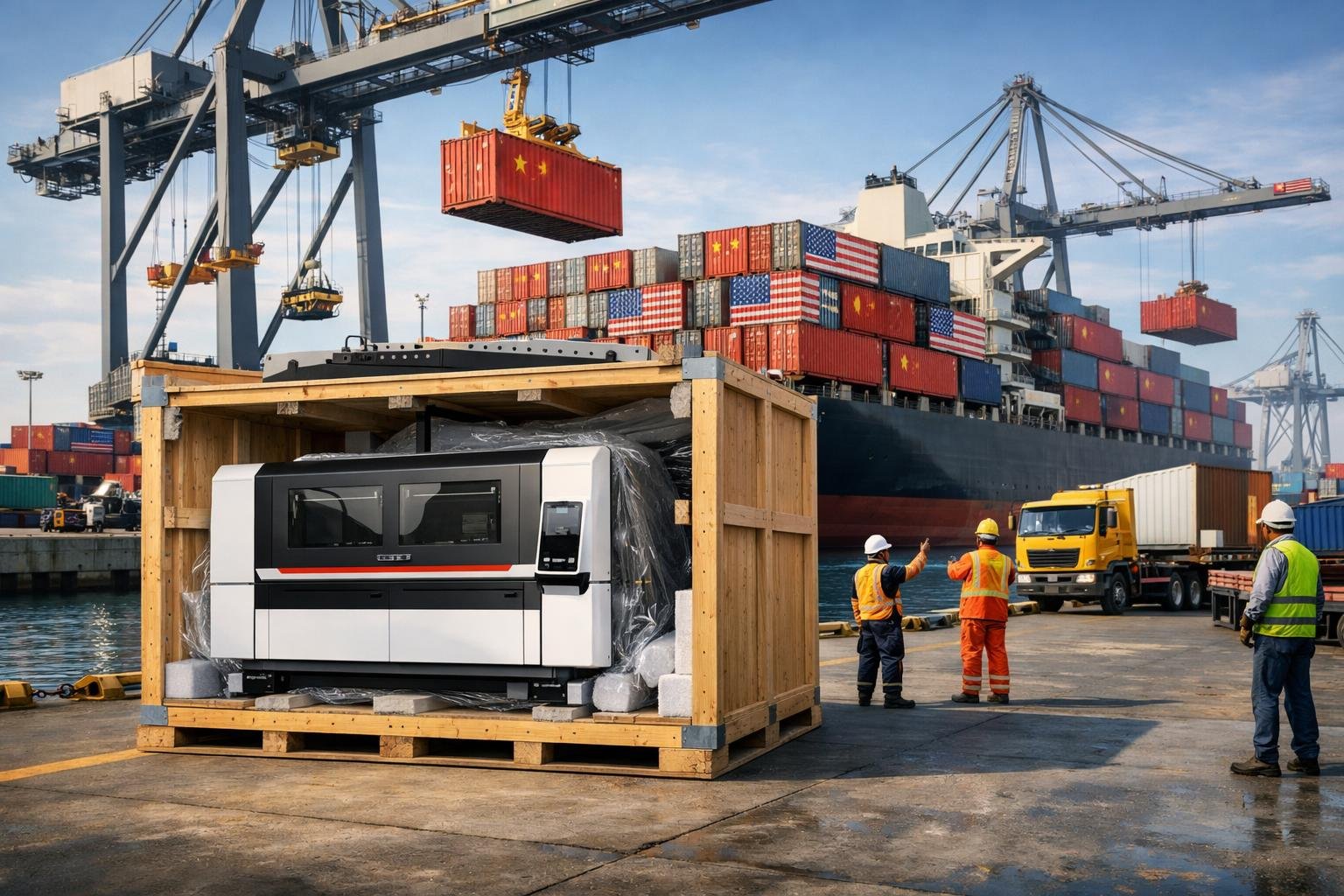
Laser Cutting Machine Shipping China to USA: Complete Guide
📅 April 08, 2026
If you’re looking into laser cutting machine shipping China to USA, you’re not alone. Many buyers want to save money by importing directly, but the process has a lot of steps—far more than just clicking “buy.”
You’ll need to wrap your head around shipping methods, customs, import duties, and how to deal with freight forwarders. Missing a detail can mean expensive delays or surprise fees.
The total shipping timeline for laser cutting machine shipping China to USA usually takes 4 to 8 weeks. Your choice between sea or air freight, and your paperwork—like commercial invoices, bills of lading, and FDA declarations—can all affect the timeline.
Importing a fiber laser cutter from China means dealing with HS codes, tariffs, and customs clearance. These details can make or break the whole purchase.
This guide covers each step of laser cutting machine shipping China to USA. You’ll see which shipping methods are cheapest, what documents you need, how to estimate total costs, and what mistakes first-timers often make.
Key Takeaways
- Laser cutting machine shipping China to USA takes 4 to 8 weeks by sea, and you need the right customs documentation and FDA compliance.
- Total costs include the machine, shipping, import duties (10-30%), installation, and customs broker fees.
- Working with suppliers who offer DDP shipping and local U.S. support makes things easier and less risky.
Understanding Laser Cutting Machine Shipping from China to USA
Laser cutting machine shipping China to USA isn’t just about moving a big box across the ocean. You’ve got to plan for shipping methods, costs, and what Chinese manufacturers actually provide.
You’ll need to know your machine specs and set up logistics ahead of time.
Key Challenges and Benefits
Shipping a fiber laser cutter from China? There are some real headaches. These machines can weigh over 500kg, which bumps up freight costs and makes handling tricky.
Customs clearance needs all your paperwork in order—commercial invoices, packing lists, specs, the whole lot.
Main challenges include:
- Freight costs for heavy machinery
- Customs duties and clearance
- Proper crating and protection
- Delays at ports
But let’s be honest, most buyers still think it’s worth it. You get advanced machines at prices that beat American or European brands by a big margin.
Chinese manufacturers have really stepped up quality, using decent components and not just cheap stuff. If you work with an experienced freight forwarder, delivery times are usually predictable.
Why Import from China
China leads the fiber laser cutting machine market. Their manufacturing scale and cost advantages are tough to beat.
With laser cutting machine shipping China to USA, you can pay 30-50% less than for local machines. Brands like Senfeng have built solid reputations for reliability.
Honestly, the tech gap between Chinese and Western machines has mostly closed. You get precision and durability at a lower cost.
Importing from China also means you get the newest models and features sooner. Chinese factories update their tech fast.
Typical Machine Specifications
Most fiber laser cutting machines shipped to the U.S. run from 1kW to 30kW. For general metalwork, 3kW to 12kW is the sweet spot.
Standard working areas are 1500mm x 3000mm up to 2000mm x 6000mm. The machines weigh anywhere from 2,000 to 8,000 kg, depending on size.
- Weight: 2,000-8,000 kg
- Power: 220V or 380V, three-phase
- Cutting thickness: Up to 25mm for steel
- Accuracy: ±0.03mm
Your laser cutting machine will arrive packed in custom wooden crates. For bigger models, shipping dimensions can exceed 4 meters in length.
Double-check your facility’s electrical setup and floor space before delivery.
Shipping Methods and Options
Ocean freight is cheaper but slower. Air freight is quick but pricey.
Most laser cutting machines ship by sea in containers, then go by truck to your shop.
Sea Freight: FCL and LCL Explained
FCL (Full Container Load) means you get an entire 20ft or 40ft container. It’s the best option for big machines or shipping several at once.
FCL gives you faster port clearance and less chance of damage, since your cargo isn’t mixed with others.
LCL (Less than Container Load) lets you share a container. You pay for just the space you need—good for smaller machines.
From Shanghai or Ningbo to the U.S. West Coast, it’s about 15-20 days by sea. East Coast takes longer, usually 28-35 days.
For reference, a typical CO2 laser cutting machine is about 12 feet long, 6.6 feet wide, and weighs around 2,000 pounds crated.
Air Freight and When to Use It
Air freight gets your laser machine to the USA in 5-10 days. But it costs a lot more—figure $4-8 per kilogram.
If you need the machine urgently, or downtime is expensive, air is sometimes worth it. High-value machines sometimes travel by air for better handling.
Cargo planes can handle up to about 3,000 pounds, but big industrial laser cutters usually go by sea.
Truck Delivery and Final Transportation
Once your laser machine clears customs, a truck delivers it to your door. This part takes 2-7 days, depending on how far you are from the port.
West Coast deliveries are quicker than shipping all the way to the East Coast. Ask for air-ride trailers—they’re gentler on sensitive equipment.
The trucking team will strap and block your crate to keep it secure. Make sure your dock and equipment can handle the weight when it arrives.
Choosing the Right Incoterms and Quotation
The incoterm you pick for laser cutting machine shipping China to USA decides who pays for what, and when risk shifts from seller to buyer.
Get a clear quote based on your incoterm, or you might get hit with surprise costs at customs or delivery.
FOB, CIF, and DDP: What They Mean
FOB (Free on Board) means your supplier handles everything until the machine is loaded on the ship. After that, you pay for shipping, insurance, customs, and delivery.
This gives you more control over shipping and lets you pick your own forwarder.
CIF (Cost, Insurance, and Freight) means the supplier pays for shipping and basic insurance. You still handle customs and delivery once it hits the USA.
But with CIF, your supplier chooses the freight company, so you might not get the best rates.
DDP (Delivered Duty Paid) is the easiest for you. Your supplier pays for shipping, customs, and delivery to your door. It’s less hassle but costs more, since suppliers add a markup for the extra work.
How to Request a DDP Quote
When you ask for a DDP quote, give your exact delivery address and mention your loading dock setup. These details matter for big, heavy machines.
Ask the supplier to split out machine cost, shipping, duties, and taxes. That way, you can compare quotes and spot any hidden fees.
Check who handles customs clearance. Some suppliers use U.S. brokers, others expect you to do it—even with DDP. Get it in writing to avoid surprises.
Managing Risks with Cargo Insurance
Standard CIF insurance covers very little. For a laser cutting machine worth tens of thousands, that’s risky.
Buy extra insurance covering the full replacement value. Your freight forwarder can usually help with this. It costs about 0.5% to 2% of the machine’s value.
Make sure coverage includes loading, transit, and unloading. Check the policy for exclusions—most won’t cover bad packaging or financial losses from delays.
Take photos of the packaging before it ships. If you need to file a claim, photos can really help.
Essential Documents and Legal Requirements
Importing machinery from China to the USA means dealing with a pile of paperwork. Customs wants to see detailed documents before your laser cutting machine can enter the country.
Commercial Invoice and Packing List
Your commercial invoice is the main document for customs. It must show the manufacturer’s name, item description, price, value, and payment terms.
Don’t forget to list the correct HS code for your machine—customs uses this to figure out duties.
The packing list goes with your invoice. It details the number of packages, crate sizes, weights, and how everything’s packed.
Customs checks both documents for matching info. If the numbers or descriptions don’t line up, expect delays or inspections.
Laser Cutting Machine Shipping China to USA: Bill of Lading and Certificate of Origin
Laser Cutting Machine Shipping China to USA requires several key documents. The bill of lading acts as your receipt from the shipping carrier and proof of ownership for your laser cutting machine.
You get either an ocean bill of lading for sea freight or an air waybill for air shipments. Once you meet payment terms, you receive this document and can claim your equipment at the destination port.
Your certificate of origin proves where your laser cutter was made. This document decides which tariffs apply and whether you qualify for any trade agreement benefits.
China-origin laser cutting machines often face different duty rates than those from countries with special trade status with the United States. Always double-check the origin to avoid surprises.
Import License and CE Certificate
Most laser cutting machines entering the USA don’t need a general import license. Still, you should verify your specific equipment isn’t on a restricted list.
FDA Form 2877 must be completed when importing laser machines because the FDA regulates these devices to protect public health and safety. It’s a step you can’t skip.
While a CE certificate shows your laser cutter meets European safety standards, U.S. customs doesn’t require it by law. Having this certification does show your machine meets international quality benchmarks, though.
U.S. safety standards from groups like OSHA and national electrical codes still apply. Make sure your equipment matches these, or you’ll run into trouble during setup.
Customs Clearance and U.S. Import Duties
Laser Cutting Machine Shipping China to USA means you’ll have to deal with customs clearance and pay import duties. Trade tensions between the U.S. and China have led to higher import tariffs on laser equipment, so understanding the costs is crucial.
Navigating U.S. Customs Procedures
Your laser cutting machine must meet all U.S. regulations before it can enter the country. Laser products imported into the U.S. must be certified, or customs will stop and impound them.
You’ll need to provide a commercial invoice, packing list, and bill of lading for customs clearance. The Harmonized Tariff Schedule assigns classification codes to your machinery based on its function and specs.
Most laser cutting machines fall under HTS codes 8456.11.00 or similar categories. A customs broker can help classify your machine and prevent delays at the port.
Section 301 Tariffs and Import Regulations
Section 301 tariffs hit many products from China, including laser equipment. These tariffs can raise your import costs by a lot.
The tariff rate depends on your machine’s specific HTS code. Most agricultural equipment enters duty-free, but industrial laser cutting machines are treated differently.
Check current rates using the official HTS database or a tariff calculator. Additional duties, like antidumping fees, may apply to some models and increase your costs.
Calculating and Paying Duties
Your total duty is based on the machine’s declared value, which includes purchase price, shipping, and insurance. Duty rates vary by machinery type and classification.
You must pay duties before customs will release your laser cutting machine. Payment can go through your customs broker or be made directly using ACH, check, or other approved methods.
Budget for extra fees too. These include merchandise processing fees (usually 0.3464% of shipment value) and harbor maintenance fees for ocean shipments.
Delivery, Warehousing, and Installation
Laser Cutting Machine Shipping China to USA doesn’t end at customs. Your machine needs proper handling from the port to your facility.
Most shipments clear customs in 1-3 days, then move to temporary storage or straight to your site for setup and training.
Receiving at U.S. Ports and Bonded Warehouses
Your laser machine usually lands at West Coast ports like Los Angeles or Long Beach after 15-20 days at sea. East Coast ports take 28-35 days, but port congestion can add 3-10 days in busy seasons.
Customs clearance for CNC machines usually takes 1-3 days if your paperwork is in order. Your customs broker files entry documents and pays duties.
Bonded warehouses let you store your machine without paying duties right away. Use bonded storage if you need to delay duty payment, arrange final transport, or split and repackage cargo before delivery.
- Delay duty payment until you’re ready to move the equipment
- Store the machine while arranging final transport
- Split shipments or repackage cargo before delivery
Most bonded warehouses charge $50-150 per day for storage. You’ll owe duties when your laser machine leaves the bonded warehouse for delivery.
Distribution Centers and Final Delivery
After customs clearance, your laser cutting machine goes to a distribution center or straight to your facility. Inland transport takes 2-7 days, depending on distance.
Your freight forwarder arranges trucking with air-ride trailers to reduce vibration. These trailers protect sensitive parts like linear guides and laser optics.
Coordinate delivery timing with your facility. Check that your loading dock can handle the weight and size—most laser cutting machines weigh 2,000-15,000 pounds and need a forklift or crane for unloading.
Oversized machines wider than 12 feet need escort vehicles and special permits. Some states require both front and rear escorts for loads over 14 feet wide.
Installation and Training After Arrival
Professional installation helps your laser cutting machine work right from day one. Most Chinese manufacturers include installation and training in their service package.
The install team unpacks your machine, checks for shipping damage, and puts it on a level foundation. They reconnect electrical cables, pneumatic lines, and any parts removed for shipping.
Spare parts and consumables usually arrive with your machine. These include laser tubes, focus lenses, mirrors, and nozzles—keep these handy for future maintenance.
Operator training lasts 2-5 days. The technician shows your team how to load materials, set cutting parameters, do maintenance, and fix common problems. Ask for training manuals and videos in English.
Supplier, Manufacturer, and After-Sales Considerations
Choosing the right manufacturer and planning for support will impact your machine’s performance and lifespan. Strong after-sales service and reliable access to parts matter as much as the purchase price.
Selecting Trusted Manufacturers or Alibaba Suppliers
Always check a manufacturer’s export experience before you buy. Companies that attend U.S. trade shows like Fabtech are usually more committed to the American market.
Ask for customer references, video demos, and factory audit reports during your evaluation. Choosing a reputable supplier with U.S. operations helps reduce communication problems and service delays.
On Alibaba, check the supplier’s transaction history and verified status. Many sellers there are middlemen, not real manufacturers. Try to contact the factory directly for better pricing and clearer technical support.
Confirm the manufacturer has FDA compliance for laser safety and CE marking. These certifications show the equipment meets U.S. safety standards.
After-Sales Support and Spare Parts Management
Your machine will need regular replacement of consumables like nozzles, lenses, and protective windows. Make sure the manufacturer keeps a U.S. warehouse with these parts in stock before you buy.
Local service centers and technicians cut downtime when issues come up. Some Chinese manufacturers, like SENFENG, have offices in California and Chicago for faster support.
Ask about remote troubleshooting and training materials. The supplier should offer 24/7 remote support and online manuals in English. You need technical help no matter the time zone.
Set up a maintenance schedule and order critical spare parts in advance. Shipping individual parts from China can take weeks, so keeping consumables on hand avoids production delays.
Frequently Asked Questions
Laser Cutting Machine Shipping China to USA costs depend mainly on your machine’s weight and size. Transit times range from a few days by air to several weeks by sea.
Import duties and proper documentation play a major role in clearing U.S. customs. Missing paperwork can cause headaches and delays.
What factors most affect the total shipping cost for a laser cutting machine imported from China to the United States?
Your laser cutting machine’s weight and dimensions drive the base shipping cost. Heavier machines need special handling and take up more space in containers or planes.
The shipping method you pick makes a big difference. Sea freight typically costs $1,500-$2,800 for container shipping, while air freight can run 5-10 times higher but is way faster.
Full Container Load (FCL) versus Less than Container Load (LCL) changes your per-unit shipping rate. FCL is better for machines over 15 tons or when shipping several at once. LCL works for smaller machines under 10 tons if you don’t mind sharing container space.
Fuel surcharges, port fees, and inland trucking from port to facility all add to the base freight rate. Insurance costs depend on your machine’s value and the coverage you want.
Seasonal demand affects pricing too. Summer usually has higher shipping rates than winter due to more cargo moving.
How long does ocean freight versus air freight typically take for delivering an industrial laser cutter from China to the USA?
Ocean freight takes 15-35 days depending on departure and arrival ports. West Coast destinations like Los Angeles get shipments faster than East Coast ports.
Sea freight transit runs 25-40 days when you count loading, sailing, and unloading. Customs clearance after arrival can add a few more days.
Air freight delivers your machine in 3-7 days from pickup in China to major U.S. cargo airports. Main hubs are Los Angeles, JFK, and Chicago O’Hare.
LCL shipments take longer than FCL because your cargo gets consolidated at warehouses before shipping. This adds 3-7 days to transit time.
Express courier services finish delivery in 2-5 business days, but only work for small laser cutting components under 150 pounds. Not really an option for full-sized machines, honestly.
Laser Cutting Machine Shipping China to USA: What import duties, tariffs, and taxes apply?
Laser Cutting Machine Shipping China to USA brings up a lot of questions about costs. The HS code for your laser cutting machine sets the duty rate you’ll pay when importing to the United States.
These 10-digit codes classify machinery for customs. The first six digits are used worldwide, while the last four are unique to the U.S.
Industrial laser cutting machines often get hit with standard tariffs and sometimes extra China-specific tariffs. The exact percentage? That depends on how customs classifies your machine and what’s happening with trade policies right now.
You figure out duties based on the machine’s declared value. That’s the price you actually paid your Chinese supplier, shown on your commercial invoice.
Some machinery gets in with lower or even zero duties because of trade agreements. Agricultural equipment, for example, often avoids duties, but industrial machinery usually doesn’t.
U.S. Customs uses your commercial invoice to decide the total taxes and duties. A good freight forwarder or customs broker can estimate the amount before your laser cutting machine shipment arrives.
Which shipping terms (Incoterms) are most commonly used for Laser Cutting Machine Shipping China to USA, and how do they change buyer responsibilities?
FOB (Free On Board) puts the responsibility on you once your laser cutting machine loads onto the ship at the Chinese port. From there, you handle ocean freight, insurance, and all costs.
CIF (Cost, Insurance, and Freight) means your Chinese supplier pays for shipping and basic insurance to your U.S. port. Once the machine arrives, you take over—customs clearance and delivery are on you.
EXW (Ex Works) gives you total control from the start. You manage everything, even the pickup from the Chinese factory, so it takes more coordination.
DDP (Delivered Duty Paid) puts all the work on your supplier. DDP shipping delivers your laser machine straight to your workshop with all fees included—shipping, customs, duties, everything.
Your Incoterm choice changes your cost and risk. FOB and EXW give you more control but also more to organize. DDP is easier, but you might pay a premium.
What documents and compliance requirements are needed to clear U.S. customs for Laser Cutting Machine Shipping China to USA?
The bill of lading is your main shipping contract and proves you own the laser cutting machine. You’ll need the original to claim your machine at the port.
Your commercial invoice is the official sales receipt and customs declaration. It must list both buyer and seller, describe the machinery with HS codes, show unit prices in USD, and mark the country of origin.
A detailed packing list helps customs see how your machine is packed and marked. It should match your invoice exactly—weights, dimensions, package counts, all of it.
You’ll also need a Certificate of Origin if you want duty breaks, and quality inspection certificates to prove your laser cutting machine meets standards. Depending on your machine, safety and environmental compliance documents might be needed too.
Electrical laser cutting machines might require UL or FCC approval. Your Chinese supplier should send you most compliance documents before shipping, but double-check that all certificates are current and match your machine.
Laser Cutting Machine Shipping China to USA: How to Crate, Insure, and Protect Your Equipment
Laser Cutting Machine Shipping China to USA requires careful planning. Heavy laser cutting machines need custom wooden crates or steel frames for protection during ocean transport.
Use sturdy wooden supports, steel straps, and thick wrapping to secure sensitive parts. Don’t forget to block the machine tightly so it doesn’t shift around.
Before shipping, always remove all fluids and disconnect the batteries. Drain hydraulic systems, lubricants, and coolants down to safe minimums to avoid leaks and meet safety rules.
Use moisture-resistant materials for packing. Toss in some desiccants inside the crate to keep rust at bay during the long ocean trip.
Put rust-preventive coatings on any exposed metal. Vapor barrier films add another layer of defense against moisture.
Some precision laser parts really need climate-controlled containers to keep temperature and humidity steady. Standard containers protect against weather and theft, but they won’t control the internal climate.
Insurance costs depend on the value you declare for the machine and how much coverage you want. Snap detailed photos and document every step of the packaging process—trust me, this helps if you ever need to file an insurance claim or deal with customs.
If you’re shipping your laser cutter on a flat rack container, secure it with strong chains and blocks. It’s worth taking the extra time to make sure nothing shifts or gets damaged in transit.
Ready to Ship from China to USA?
Get a free quote from our logistics experts today.
Get a Free Quote →