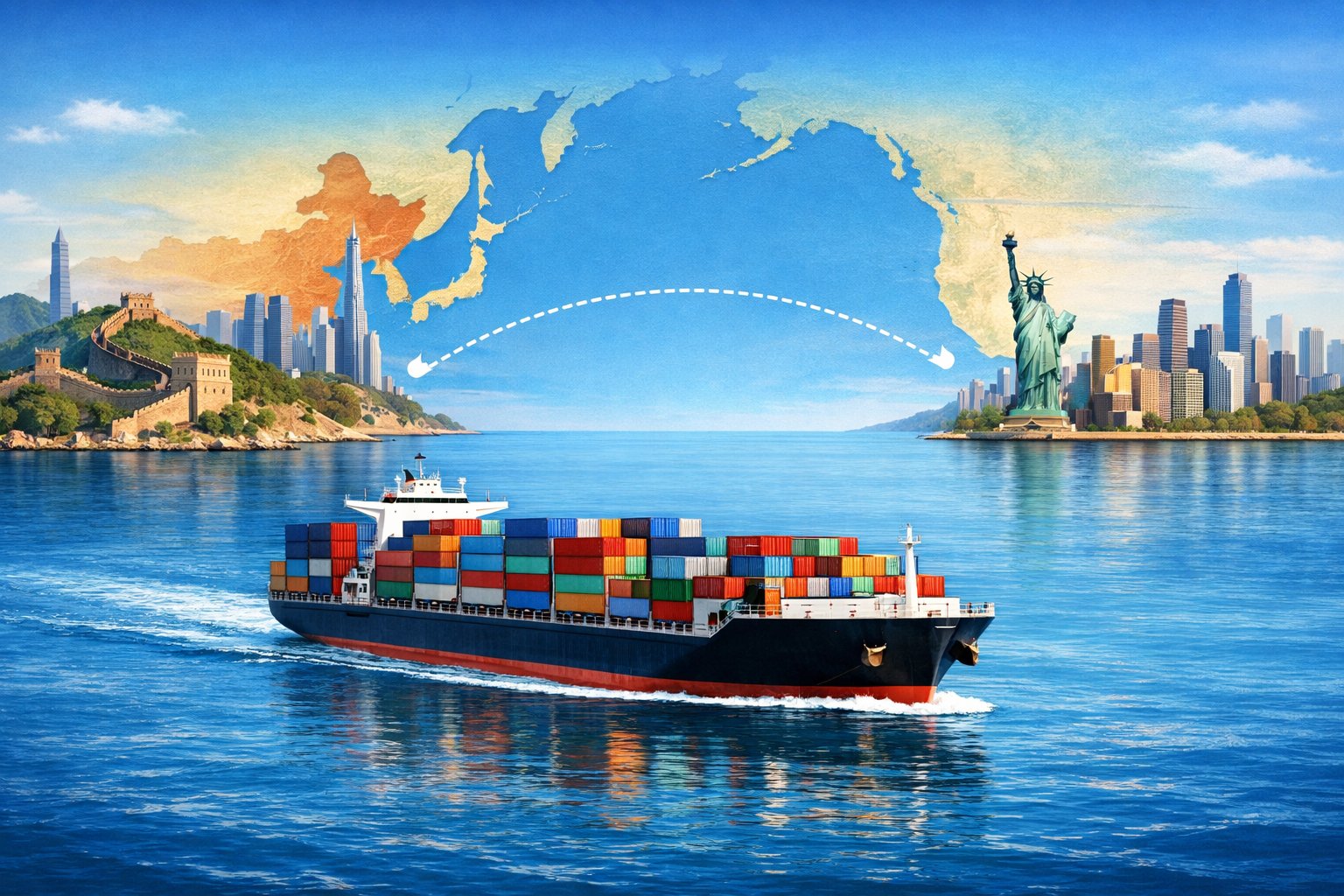
Sea Freight China USA: Complete Guide on Costs, Routes & Delivery
📅 January 27, 2026
Sea Freight China USA dominates global trade, moving more than 90% of cargo between these two economic giants. If you’re shipping large quantities of goods, it’s hands-down the most cost-effective way to cross the Pacific.
Whether you’re running a scrappy e-commerce shop or managing imports for a big brand, getting a grip on sea freight China USA can save you money and headaches. If you don’t understand the basics, you risk delays and surprise costs. Nobody wants that.
Shipping from China to the US isn’t just about tossing a container on a ship. You need to pick the right container type, know your transit times, and choose the best ports.
Customs requirements matter too. Freight rates keep shifting as new ships hit the market, which means more competitive pricing for importers. It’s a moving target.
This guide unpacks everything you need about sea freight China USA. You’ll see the differences between full and shared containers, figure out the must-have documents, estimate delivery times, and spot ways to trim costs.
We’ll dig into the main shipping routes, port choices, and customs steps. With the right info, you can plan your shipments and dodge the usual pitfalls.
Key Takeaways
- Sea freight is the cheapest shipping method for moving large or heavy goods from China to the USA.
- Transit times range from 14-20 days to West Coast ports and 28-35 days to East Coast destinations.
- Proper documentation and customs clearance are essential to avoid delays and unexpected fees.
Understanding Sea Freight China USA: The Basics
Sea freight China USA moves cargo in big metal containers loaded onto massive ships. Shipping lines and freight forwarders coordinate the logistics between Chinese ports and American destinations.
This method powers most physical goods traded between the two countries. It’s the backbone of global trade, honestly.
What Is Sea Freight and How Does It Work?
Sea freight means moving goods by cargo ships across the ocean. When you ship from China to the USA, your products go into standard 20-foot or 40-foot containers.
You start by booking space with a shipping line or a freight forwarder. Your goods leave the factory, head to a Chinese port—maybe Shanghai or Shenzhen—and get loaded onto a vessel.
Ships follow set routes across the Pacific to big U.S. ports like Los Angeles, Long Beach, Seattle, and New York. The trip usually takes 14 to 35 days, depending on your ports.
After docking, port crews unload containers. Customs officials inspect and clear your shipment before it moves on to its final stop.
Major Shipping Players and Their Roles in Sea Freight China USA
Shipping lines own and run the ships that haul your cargo. Big names are Maersk, MSC, COSCO, and Evergreen. They set rates, publish schedules, and keep the vessels moving.
Freight forwarders act as your logistics partner. They don’t own ships but handle the paperwork, customs, and inland transport. Forwarders can often score better rates by pooling shipments.
Port operators manage the terminals. Customs brokers handle government paperwork. Trucking companies move containers between ports and warehouses. Every player keeps global commerce running, each in their own way.
Why Choose Sea Freight China USA Over Other Modes?
Sea freight costs way less than air freight for most shipments. If you’re moving bulk orders, heavy machinery, or lower-margin goods, it’s a no-brainer. Shipping from China by sea usually costs $1 to $4 per kilogram, while air can run you $5 to $8 per kilogram.
Container ships can handle almost anything—oversized equipment, cars, even goods needing refrigeration. There’s basically no limit to your shipment size, since these ships carry thousands of containers each trip.
Ships also emit less carbon dioxide per ton than planes. Transit times are longer, but the trade-off in cost and capacity makes sea freight the main engine of international trade between China and the USA.
Shipping Options: FCL vs. LCL for Sea Freight China USA
When you’re shipping goods from China to the USA by sea, you pick between two main options. FCL gives you the whole container, while LCL lets you share with other shippers.
Full Container Load (FCL) Shipping
Full Container Load means you get a container all to yourself. Your cargo gets loaded, sealed, and stays untouched until it arrives.
Pick from three standard sizes. A 20ft container (20GP) holds about 28 cubic meters—great for heavy stuff. A 40ft container fits around 58 cubic meters. The 40ft high cube gives you 68 cubic meters, perfect for lighter, bulkier cargo.
FCL starts making sense when your shipment hits 10-13 CBM. Below that, you’re paying for empty space. Above it, your per-unit costs drop fast.
Transit times run 18-25 days port to port, or 25-35 days door to door. Your goods face less handling, so there’s less risk of damage and better security.
Less Than Container Load (LCL) Shipping
Less than container load lets you pay just for the space you use in a shared container. Your cargo gets consolidated at the origin warehouse, then separated out at the destination.
LCL works best if you’re shipping under 10 CBM. Expect to pay $120-$200 per CBM for the ocean leg, plus $50-$90 per CBM in destination charges.
It takes longer, though. The ocean trip is still 18-25 days, but add 3-7 days for consolidation at origin and another 3-7 for deconsolidation at the destination. Door-to-door, you’re looking at 35-45 days, or 45-55 days in peak season.
Your cargo gets handled more, so there’s more risk of damage. You also can’t control departure schedules since the warehouse waits to fill the container.
How to Choose Between FCL and LCL for Sea Freight China USA
Your cargo volume decides which one’s cheaper. Do the math: divide the FCL container rate by the LCL per-CBM rate.
Say a 40ft container runs $4,000 and LCL is $150 per CBM. The break-even is 27 CBM. Below that, LCL is better. Above, go FCL.
Timing can tip the scales too. If you need it fast, FCL can save you 10-20 days over LCL. That matters for Amazon FBA or tight deadlines.
High-value or fragile goods do better with FCL. Less handling means less risk of damage from someone else’s cargo.
Special containers—like refrigerated ones—are only available as FCL. You can’t share temp-controlled space through LCL.
Sea Freight China USA: Routes and Major Ports
There are two main shipping routes connecting China and the USA. Your choice of port and route affects delivery speed and the risk of delays.
Primary Shipping Routes: Pacific vs. Panama Canal
The Trans-Pacific route links China to the West Coast. This North Pacific lane takes 14 to 20 days—fast and direct.
The Panama Canal route serves the East and Gulf Coasts. Your cargo crosses the Pacific, passes through the canal, and heads to Atlantic ports. It takes longer, but opens up major eastern markets.
Route Comparison:
Route Transit Time Best For North Pacific 14-20 days West Coast delivery Panama Canal 25-35 days East Coast, Gulf ports ### Key Origin and Destination Ports for Sea Freight China USA
China’s top shipping ports include Shanghai, Shenzhen, Yantian, Ningbo-Zhoushan, and Qingdao. These handle most containerized exports to the US.
On the West Coast, your goods usually land at Los Angeles, Long Beach, or Oakland. LA and Long Beach form the biggest port complex in North America. Seattle is another big entry point.
East Coast options include New York/New Jersey, Savannah, and Houston. Port choice affects your shipping time, cost, and logistics. West Coast is faster, but inland transport costs can climb if your destination is in the east.
Port Congestion and Real-World Challenges
Port congestion can derail your schedule and add costs. West Coast ports often get jammed up during peak seasons. LA and Long Beach, in particular, have seen major delays that tack on days—or weeks.
Keep an eye on congestion reports when planning. Some importers reroute to less crowded ports or shift schedules to dodge the rush. Weather, labor strikes, and sudden demand spikes can all throw a wrench in your supply chain.
Sea Freight China USA: Costs and Rates
Sea freight rates from China to the US change based on container type, route, and market swings. Carriers set base rates and then tack on surcharges, which can really bump up your shipping cost from China to the US.
Factors Affecting Sea Freight China USA Rates
Sea Freight China USA rates hinge on a handful of crucial factors. Container size stands out—20-foot containers (TEU) usually cost less than 40-foot containers (FEU).
The route you pick matters, too. Shipping from Shanghai to Los Angeles, for example, often comes with lower rates than less popular port pairs because there are simply more ships running that route (see here).
How much you ship affects your total cost. Full Container Load (FCL) rates are flat per container, no matter how much you cram inside.
Less than Container Load (LCL) rates work per cubic meter. They’re best for smaller shipments—think under 15 cubic meters.
Market demand, especially when it’s hot, pushes up ocean freight rates. If space is tight, carriers bump up prices fast (market demand info).
Your cargo’s weight and what you’re shipping also matter. Hazardous or temperature-sensitive goods usually cost more (cargo weight details).
Freight Rate Types and Surcharges in Sea Freight China USA
Base ocean freight rates are just the beginning for your Sea Freight China USA costs. Carriers tack on mandatory surcharges, sometimes hiking your bill by 30-50%.
The Bunker Adjustment Factor (BAF) covers fuel swings and changes monthly with oil prices. Peak Season Surcharge (PSS) kicks in when demand spikes, mostly August through October, as retailers prep for holidays.
There’s also the General Rate Increase (GRI), which is a broad price hike carriers announce now and then. Extra fees pop up, like:
- Terminal handling at both ports
- Documentation for the bill of lading
- Container cleaning and inspection
- Chassis charges for inland moves
If you want a decent estimate before you ship, try a freight calculator to see your full landed cost.
Sea Freight China USA Rate Trends and Seasonality
Rates for Sea Freight China USA swing a lot through the year. Peak season runs July to October as retailers gear up for back-to-school and holidays.
During these months, carriers often slap on PSS fees—sometimes $500 to $1,500 per container. The slowest, cheapest stretch is late January through March, right after Chinese New Year.
Seasonal rate variations:
Period Rate Level Key Factors January-March Lowest Post-holiday slowdown April-June Moderate Gradual increase July-October Highest Peak season demand November-December High Holiday shipping Big market events—think port congestion or labor strikes—can throw these seasonal patterns out the window. If you want better rates and a spot on the ship, book 4-6 weeks ahead during peak times.
Sea Freight China USA Transit Times and Shipping Schedules
Sea freight transit times from China to USA usually run 20 to 45 days, depending on your route and shipping method. Knowing these schedules helps you plan inventory arrivals and handle time-sensitive shipments with less stress (inventory planning).
Average Sea Freight China USA Transit Times by Route
Your China to USA transit time really depends on your ports. Shanghai to Los Angeles? Figure 18 to 22 days.
Shenzhen to Los Angeles averages 20 to 25 days. East Coast ports take longer—Shanghai to New York is about 30 to 35 days, while Ningbo to Miami can hit 32 to 38 days.
The routes you pick change everything. Direct Pacific routes get you to the West Coast fastest. If you go through the Panama Canal, add 7 to 10 days, but you’ll reach East and Gulf Coast ports.
Major Route Transit Times:
Origin Port Destination Port Average Days Shanghai Los Angeles 18-22 Shenzhen Long Beach 20-25 Ningbo Seattle 16-20 Shanghai New York 30-35 Qingdao Houston 35-40 ### Factors That Impact Sea Freight China USA Delivery Schedules
Port congestion is a big wild card for Sea Freight China USA transit times. Peak shipping season (August to October) can tack on 3 to 7 extra days.
Your shipping method makes a difference. FCL (Full Container Load) clears customs faster than LCL (Less than Container Load) since you skip consolidation delays.
Switching from LCL to FCL might shave off up to 8 days. Customs clearance adds time too—complete paperwork and pre-clearance can save you 2 to 5 days.
Weather, especially during typhoon season (June through November), sometimes causes 1 to 3 day delays. The carrier you choose affects reliability—big names stick to schedules better but charge more.
How to Minimize Sea Freight China USA Delays
Book your shipments 3 to 4 weeks ahead in peak season if you can. Early booking gets you better rates and a guaranteed spot.
Use real-time tracking to watch your containers move. Digital tracking can help you spot delays and tweak your receiving plans.
Prep your documents before the cargo leaves. Pre-clearing customs while your freight is at sea can cut out headaches at the destination.
Working with experienced freight forwarders makes a world of difference—they know the rules and can speed things up.
Try to book direct sailings instead of routes with transshipment stops. Every extra port adds 2 to 4 days. For urgent shipments, paying a bit more for direct service is usually worth it.
Keep extra inventory to cover typical Sea Freight China USA transit time swings. Planning for 25 to 30 days, not the minimum, helps you dodge supply chain hiccups.
Sea Freight China USA Customs Clearance and Documentation
Getting Sea Freight China USA shipments through customs takes careful paperwork and following the rules in both countries. Knowing what’s required—and what could go wrong—can save you time and money.
Required Shipping Documents for Sea Freight China USA
You’ll need several key documents for smooth customs clearance. The commercial invoice lists your shipment’s value, description, and sale terms.
Your packing list spells out what’s inside, with weights and sizes. The bill of lading (B/L) is your proof of ownership and receipt from the carrier.
A certificate of origin shows where your goods were made. It’s crucial for tariffs and trade deals. Sometimes you’ll also need:
- Import license (for restricted stuff)
- Inspection certificates
- FDA or other regulatory approvals
- Insurance docs
If your paperwork is missing or wrong, expect delays and customs holds. Double-check that everything matches before you ship.
Customs Processes in China and USA for Sea Freight China USA
Chinese customs ask for export declarations before your cargo leaves. Usually, your freight forwarder takes care of this and makes sure you’re following the rules.
When your goods land in the USA, they go through customs clearance with U.S. Customs and Border Protection (CBP). You have to file an entry declaration within 15 days.
Most importers use a customs broker to navigate U.S. import rules. Your goods get classified with HTS codes (or HS codes), which set your customs duties rate.
CBP might inspect your shipment or review your paperwork. Clearance can take a few hours or stretch to several days. Section 301 tariffs hit many Chinese imports, adding 7.5% to 25% in duties, depending on what you’re shipping.
Common Compliance Issues with Sea Freight China USA
Wrong HTS code classification causes headaches at customs. If you use the wrong code, you might underpay duties and get hit with penalties or holds. Research your product or ask your broker for help.
Don’t undervalue your invoice. Customs checks your declared value against similar shipments and can challenge anything that looks fishy.
Missing or incomplete paperwork stops your shipment cold. Your commercial invoice needs every detail—buyer and seller info, product descriptions, quantities, prices, and total value. Make sure your packing list matches the invoice.
Some products—like food, drugs, electronics, or textiles—need special permits. If you try to import them without the right approvals, customs might reject or even destroy your goods.
Door-to-Door, Port-to-Port, and Alternative Sea Freight China USA Services
When shipping from China to the USA, you’ve got options. Go full-service with door-to-door, or handle some steps yourself with port-to-port.
Extras like consolidation and cargo insurance can help you manage risk and control costs. It’s all about finding the right fit for your Sea Freight China USA needs.
Door-to-Door and Port-to-Port Sea Freight China USA Choices
Door-to-door shipping for Sea Freight China USA covers your whole shipment journey—from your supplier in China to your doorstep in the States. Your freight forwarder arranges pickup, export customs, ocean transport, import clearance, and final delivery. You barely have to get involved in logistics.
Port-to-port service only covers the ocean freight part between China and US ports. You’ll need to arrange inland transport to the Chinese port and handle customs and delivery from the US port to your warehouse. This option is cheaper, but honestly, it means more work for you.
Door-to-port shipping sits somewhere in the middle. The freight forwarder picks up from your supplier and drops off at a US port. You take care of customs and the rest of the journey. If you’ve got a customs broker and trucking contacts in the US, this can work out pretty well.
Express and Consolidation Sea Freight China USA Services
Express shipping from China to the US uses faster vessels or multimodal transport—sometimes mixing ocean and air. Transit times drop from the usual 15-30 days down to 7-15 days. You’ll pay a premium for that speed, but sometimes it’s worth it.
Got a small shipment? Consolidate with other importers to cut costs. Consolidation combines several small loads into one container, which is perfect for LCL (less than container load) under 10-15 cubic meters.
Consolidated shipments take longer because the forwarder has to collect cargo from multiple shippers. Deconsolidation at the destination port adds more days. Still, if you’re shipping small volumes, the savings usually make up for the extra time.
Special Handling and Service Add-Ons for Sea Freight China USA
Cargo insurance protects your goods against damage, loss, or theft during the ocean trip. Most policies cover up to 110% of your cargo’s value. Insurance usually costs between 0.3% and 0.5% of the insured value. If you’re shipping expensive stuff, don’t skip this.
Shipping perishable or sensitive products? Temperature-controlled containers (reefers) keep cargo between -25°C and 25°C. These cost two to three times more than standard containers, but sometimes you just need them.
Demurrage charges kick in if you don’t pick up your container within the free window—usually 3-5 days at US ports. After that, you’re looking at $75-$150 per day per container. Stay on top of your schedule and clear customs early to avoid these fees.
Key Sea Freight China USA Shipping Considerations
Sea Freight China USA shipping isn’t just about booking a boat—it’s about picking the right partners, knowing your contracts, and prepping your cargo. If you get these things right, your goods arrive on time and in one piece.
Freight Forwarders for Sea Freight China USA
A good freight forwarder makes Sea Freight China USA much easier. They’ll book containers, coordinate pickups, handle customs, and arrange delivery to your US warehouse. Always check if your forwarder knows the China-USA route and has solid carrier relationships.
Get transparent quotes that show every cost—ocean freight, terminal fees, trucking, customs. Your forwarder should also take care of the paperwork: commercial invoice, packing list, bill of lading, and air waybill if you’re in a rush.
Choose a forwarder who can handle customs clearance and file your Importer Security Filing (ISF) on time. Miss that 24-hour window before loading? You could get hit with a $5,000 fine.
Incoterms and Trade Terms in Sea Freight China USA
Incoterms spell out who pays for what—shipping, insurance, customs—at every step. FOB (Free On Board) is the go-to for Sea Freight China USA. Your supplier delivers to the port and loads the ship; you pick the forwarder and pay for ocean freight, insurance, and US customs.
EXW (Ex Works) puts everything on you, from the Chinese factory to your US door. CIF (Cost, Insurance, and Freight) has the supplier pay up to your US port, but you cover arrival charges and customs. DDP (Delivered Duty Paid) is all-inclusive but pricier.
Most folks stick with FOB. It gives you some control and decent cost savings without making you do all the work.
Labeling and Packaging for Sea Freight China USA
Good packaging is non-negotiable for Sea Freight China USA. Use strong cardboard boxes made for container shipping. Palletize on 40×48 inch pallets so warehouses and ports can move your stuff easily.
Every box needs a clear “Made in China” label for US Customs. Add your company name, tracking number, and handling instructions. Your packing list should show what’s inside, the weight, dimensions, and carton count.
Ports in China and the US have a lot of hands on your cargo. If you skimp on packaging, expect damage and insurance headaches. Use moisture-resistant materials and strap pallets tightly. For fragile items, add corner protectors and extra padding.
Frequently Asked Sea Freight China USA Questions
Shipping from China to the USA has its quirks—different ports, timelines, costs, and paperwork depending on your route and the time of year. Understanding container types and peak season trends helps you plan and dodge surprise fees.
Main Ports for Sea Freight China USA
Shanghai is the busiest port in the world and a top choice for Sea Freight China USA. Shenzhen (Yantian and Shekou terminals) moves a ton of electronics and manufactured goods from South China.
Ningbo-Zhoushan is another strong option, and Qingdao is the hub up north. On the US side, Los Angeles and Long Beach handle most trans-Pacific cargo, but they get pretty congested. New York and New Jersey are the main East Coast ports.
Savannah’s growing fast as a Southeast gateway, and Houston connects to the Gulf Coast and inland centers.
Sea Freight China USA Transit Times
Shipping to the US West Coast usually takes 14 to 20 days port-to-port. LA and Long Beach get containers from China in about 15-16 days if all goes well.
East Coast ports take longer—28 to 35 days via the Panama Canal. Shanghai to New York is roughly 30 days just on the water.
Add another 7 to 14 days for door-to-door delivery, including trucking and customs. LCL shipments take 5-7 days longer than FCL because of consolidation and deconsolidation.
Port congestion, weather, and customs can stretch these times. In late 2025, carrier schedule reliability was only around 65%. Delays are pretty common.
Sea Freight China USA Costs
By late 2025, a 40-foot container to the US West Coast ran $2,200 to $2,650 for spot rates. East Coast rates were $3,400 to $3,900 per container.
Total landed cost is more than just ocean freight. You’ll pay terminal handling at both ends, plus trucking for pickup and delivery. Customs duties based on your product’s HS code and value add another chunk.
New container ships in 2026 have nudged freight rates down. Still, you might see fuel surcharges or peak season premiums when demand spikes.
Required Documents for Sea Freight China USA
You’ll need a commercial invoice showing what you’re shipping and its value. A packing list with contents, weight, and dimensions is a must for customs.
The Bill of Lading is your contract and receipt. Don’t forget the Importer Security Filing (ISF)—you have to file it 24 hours before loading, or you risk a $5,000 fine.
Depending on your product, you might need a certificate of origin or extra permits. Accurate paperwork keeps customs happy and your cargo moving. A customs broker can help get everything done right and on time.
Peak Season Effects on Sea Freight China USA
Peak season for Sea Freight China USA runs August to October as retailers prep for the holidays. Rates can jump fast as everyone scrambles for space.
Right before Chinese New Year, factories rush to finish orders—expect another crunch. General rate increases and surcharges are common during these windows.
Space gets tight, so book your container 2-3 weeks ahead to lock in a spot and a decent rate. March to July is slack season with lower rates and more capacity. Shipping off-peak can really lower your costs.
During peak, transit times stretch out thanks to port congestion and vessel delays. Planning around these cycles saves you money and keeps your inventory flowing.
Sea Freight China USA: LCL vs. FCL Shipping Options
Let’s talk Sea Freight China USA and the two main shipping options: LCL (Less than Container Load) and FCL (Full Container Load). These choices can really change your shipping experience, so it’s worth digging in.
FCL means you’re renting an entire container at a flat rate, no matter how much space you use. Most people go for FCL when their shipment is over 15 cubic meters.
LCL lets you share container space with others and just pay for the volume you actually use. If your shipment is under 15 cubic meters, LCL usually makes more sense.
FCL shipments usually move faster. Your container goes straight from port to destination, skipping all the combining and splitting. LCL, on the other hand, adds about 5 to 7 days since workers need to consolidate and later deconsolidate several shipments.
When you pick FCL, your goods stay sealed in one container the whole way. That lowers handling risk. With LCL, workers load and unload multiple shipments, so there’s a higher chance of damage—it’s just the nature of more touchpoints.
Tracking’s simpler with FCL. You’re following one container, start to finish. LCL tracking can get tricky, since you’re keeping tabs on your individual pallets or cartons inside a shared container.
Ready to Ship from China to USA?
Get a free quote from our logistics experts today.
Get a Free Quote →