Sea Freight from China to USA: The Most Cost-Effective Shipping Method
📅 October 20, 2025
Sea freight from China to USA is one of the most cost-effective ways to move products—but figuring out how to make it work without destroying your profit margins can feel like solving a puzzle. You know speed matters, but you also know that shipping costs can make or break your business. How do you balance cost, speed, and reliability?
You’re not alone. Countless importers, e-commerce brands, and businesses sourcing from China face the same challenge. In this comprehensive guide, we’ll demystify sea freight from China to USA, breaking down the entire process from start to finish. You’ll learn about transit times, cost factors, and the key differences between FCL and LCL shipping.
As a leading freight forwarder specializing in the China-USA trade lane, AEB Logistics has managed thousands of shipments, helping businesses like yours thrive. We’re here to turn complex logistics into a simple, streamlined process.
Key Points
- Sea Freight as the Cost-Effective Solution for China-USA Shipping: Ocean freight offers unmatched cost efficiency, especially for large-volume shipments, making it the primary choice for businesses seeking affordability in international shipping.
- Advantages of Sea Freight from China to USA: Sea freight provides vast capacity for bulk shipments, flexibility with FCL and LCL options, eco-friendliness through lower carbon footprint, and high safety and reliability due to mature industry regulation.
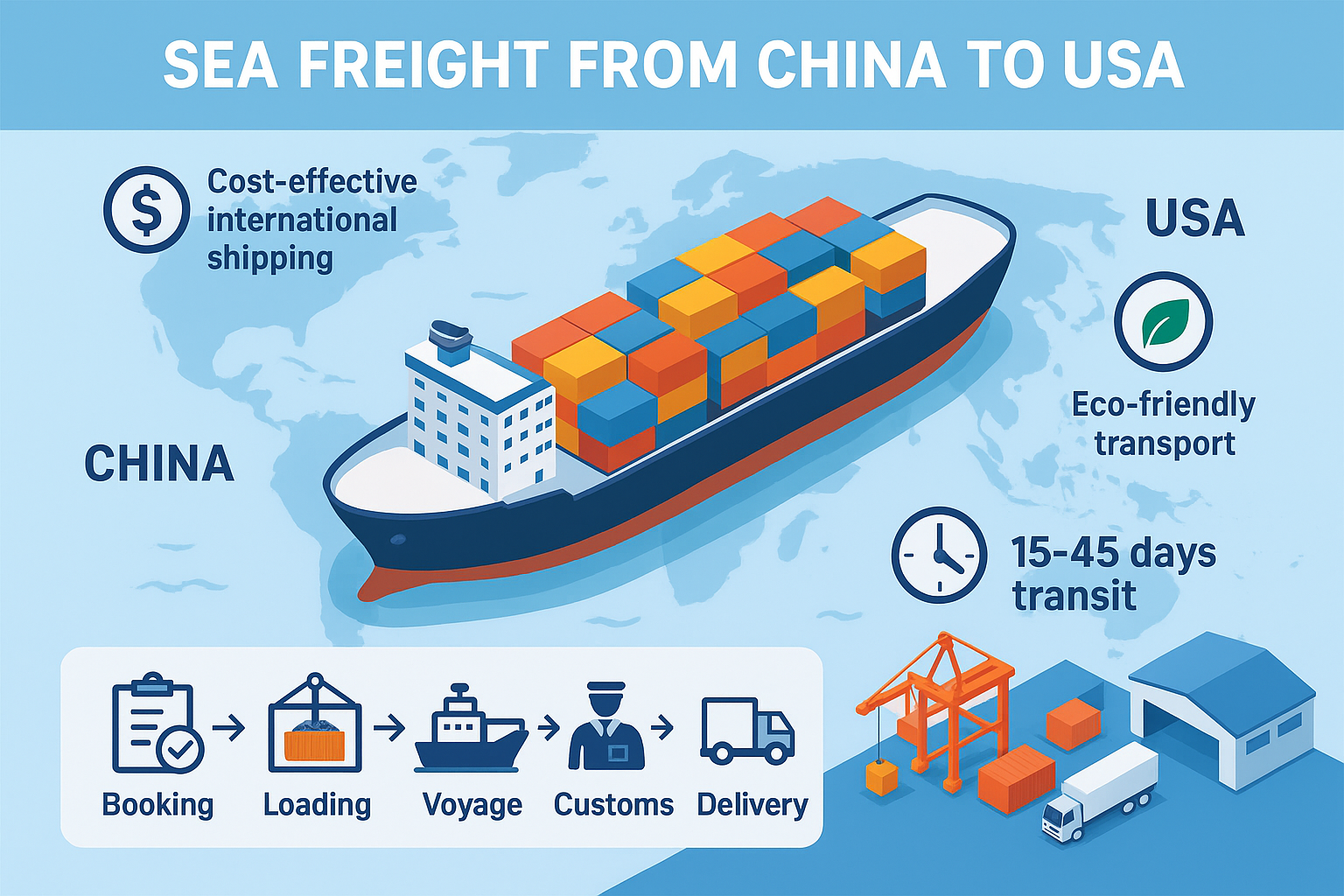
- Step-by-Step Ocean Freight Process from China to USA: The process involves booking and cargo pickup, export and port of origin procedures, the ocean voyage, port of destination and import clearance, and final delivery to the target location, all managed by a freight forwarder.
- Choosing Between FCL and LCL Shipping Options: FCL is ideal for larger shipments and offers faster, more secure transport, while LCL is suitable for smaller volumes and offers cost savings for low-volume shipments, with the break-even point around 13-15 CBM.
- Factors Affecting Sea Freight Rates and Transit Times: Rates fluctuate based on supply and demand, port locations, fuel costs, and carrier rate changes, while transit times depend on the destination port, typically 15-30 days for West Coast and 30-45 days for East Coast, plus additional ground and customs processes.
Why Choose Sea Shipping from China to USA?
When looking at your shipping options, air freight is the fastest, but it comes at a premium cost. For businesses shipping anything larger than a few small parcels, the answer almost always lies on the ocean. Ocean freight from China to USA is the backbone of global trade for one primary reason: unbeatable cost-effectiveness.
The sheer scale of modern container ships is staggering. A single vessel can carry over 20,000 twenty-foot equivalent units (TEUs), creating economies of scale that air freight simply cannot compete with. If your shipment is heavy, bulky, or you’re shipping in large quantities, sea freight offers the lowest cost per unit, maximizing your profitability.
But the benefits don’t stop at cost.
- Capacity for Bulk Shipments: There are virtually no limits on the weight or volume of goods you can ship via the ocean. From heavy machinery to thousands of boxes of consumer goods, container ships can handle it all.
- Flexibility: With options like Full Container Load (FCL) and Less than Container Load (LCL), you can tailor your shipping strategy to your exact needs, whether you have enough cargo to fill a whole container or just a few pallets.
- Eco-Friendly: While the shipping industry has a long way to go, sea freight has a significantly lower carbon footprint per ton-mile compared to air freight, making it a more environmentally conscious choice for your supply chain.
- Safety and Reliability: The ocean freight industry is mature and highly regulated. With advanced tracking and standardized processes, it is a very reliable way to move goods across the globe.
Understanding the Ocean Freight China to USA Process
The journey your goods take from a factory in Shenzhen to a warehouse in Chicago might seem complex, but it can be broken down into a clear, manageable process. As your freight forwarder, AEB Logistics manages every step, but understanding the journey is key to planning your inventory and timelines.
- Booking & Cargo Pickup: The process starts when you request a quote and book your shipment with us. We coordinate with your supplier in China to arrange for the pickup of your goods from their factory or warehouse.
- Export & Port of Origin: Your cargo is transported to the port of origin (e.g., Shanghai, Ningbo, Shenzhen). Here, it’s loaded into its container (if LCL, it’s consolidated with other shipments) and clears Chinese export customs. We handle all the required documentation to ensure a smooth departure.
- The Ocean Voyage: This is the longest part of the journey. The container ship travels across the Pacific Ocean. During this time, you can follow its progress, and we provide updates on its estimated arrival. You can learn more about how to track your shipment here.
- Port of Destination & Import: The ship arrives at the designated U.S. port (e.g., Los Angeles, New York). The cargo is unloaded and must clear U.S. Customs. Our expert customs brokerage team manages this critical step, ensuring all duties and taxes are paid and regulations are met.
- Final Delivery: Once cleared, your container is picked up from the port and transported to its final destination. This could be your warehouse, an Amazon FBA center, or a 3PL facility. We utilize our reliable trucking network to ensure prompt and safe last-mile delivery. If needed, we can also arrange for temporary storage in our secure warehousing facilities.
FCL vs. LCL: Which Sea Freight Service is Right for You?
One of the first questions you’ll face when booking China to USA sea freight is whether to use FCL or LCL. This choice directly impacts your cost, transit time, and security.
FCL (Full Container Load) Shipping
FCL shipping means you are renting the exclusive use of a standard 20-foot or 40-foot container. Your goods are the only items in that container.
- Best for: Larger shipments, typically over 15 cubic meters (CBM). If your volume is close to filling a container, FCL is almost always more cost-effective than LCL.
- Advantages:
- Faster: FCL shipments don’t need to be consolidated at the origin or de-consolidated at the destination. This can save several days in transit time.
- More Secure: The container is sealed at your supplier’s factory and is only opened upon arrival at your destination, reducing the risk of damage or loss.
- Flat Rate: You pay a single flat rate for the container, regardless of how full it is.
LCL (Less than Container Load) Shipping
LCL shipping is the solution for smaller shipments that don’t require a full container. Your cargo is consolidated with goods from other shippers into a shared container.
- Best for: Smaller businesses, startups, or anyone shipping lower volumes (typically 2-15 CBM).
- Advantages:
- Cost-Effective for Small Volumes: You only pay for the space you use, calculated in cubic meters.
- Flexibility: LCL allows you to ship smaller quantities more frequently, which can be great for managing inventory and cash flow.
- Accessibility: It opens up the cost benefits of sea freight to businesses that cannot fill an entire container.
Expert Tip: The break-even point between LCL and FCL is typically around 13-15 CBM. If your shipment is in this range, it’s always worth getting quotes for both options. Sometimes, a 20-foot FCL container can be cheaper and faster than a large LCL shipment.
Navigating Sea Freight Rates from China to USA
Sea freight rates from China to USA are not static; they are dynamic and influenced by a variety of global economic factors. Understanding these factors will help you budget more effectively and know when to expect price shifts.
Key factors that influence sea freight China USA costs include:
- Supply and Demand: The primary driver. During peak season (typically August-November before the holidays), demand for container space skyrockets, pushing prices up.
- Port of Origin/Destination: Shipping from a major port like Shanghai to the Port of Los Angeles will have different rates than a less common route.
- Fuel Costs (BAF): The Bunker Adjustment Factor (BAF) fluctuates with global oil prices.
- General Rate Increases (GRIs): Carriers can announce GRIs at certain times of the year, which can significantly impact rates.
- Incoterms: The agreed-upon shipping terms (e.g., FOB, EXW) determine who pays for which part of the shipping process, directly affecting your final invoice.
To get an accurate and up-to-date cost, the best approach is always to request a custom quote. Our team at AEB Logistics provides transparent, all-inclusive quotes with no hidden fees.
China to USA Sea Freight Transit Times: What to Expect
Patience is a virtue when it comes to ocean freight. While it’s the most economical option, it’s also the slowest. Planning your supply chain around realistic transit times is crucial for keeping your business running smoothly.
Transit time is primarily affected by the destination port in the USA:
- China to US West Coast (e.g., Los Angeles, Long Beach, Seattle): The port-to-port ocean journey typically takes 15 to 30 days.
- China to US East Coast (e.g., New York/New Jersey, Savannah): Since these shipments must travel further, often through the Panama Canal, the port-to-port journey takes approximately 30 to 45 days.
Important Note: This is the port-to-port time only. You must also factor in the time for ground transport in China, customs clearance at both ends, and final delivery in the USA. A safe estimate for your total door-to-door transit time is to add an extra 1-2 weeks to the ocean voyage time.
Master Cost-Effective Sea Freight from China to USA
As we’ve seen, sea freight from China to USA is the undisputed champion for any business looking to ship bulk goods in a cost-effective and reliable manner. By understanding the core process, choosing between FCL and LCL, and planning for realistic transit times, you can master your supply chain and build a more profitable business. The complexities of international logistics don’t have to be a barrier to your success.
Now that you have the knowledge, you’re equipped to make smarter shipping decisions. What’s the biggest challenge you’ve faced with your international shipments? Share your experience or questions in the comments below!
FAQs:
What makes sea freight from China to USA the most cost-effective shipping method?
Sea freight from China to USA is the most cost-effective shipping method for large-volume shipments due to economies of scale, the ability to carry extensive quantities, and lower per-unit costs compared to other transportation modes, making it ideal for maximizing profitability.
What are the main advantages of choosing sea freight for shipping from China to USA?
Sea freight offers advantages such as vast capacity for bulk shipments, flexibility with FCL and LCL options, a lower carbon footprint compared to air freight, and high safety and reliability because of mature industry regulations and tracking systems.
What are the typical steps involved in the ocean freight process from China to the USA?
The ocean freight process includes booking and cargo pickup, export procedures at the port of origin, the ocean voyage, arrival and import clearance at the destination port, and final delivery to the customer’s location, all managed by a freight forwarder.
How do I decide between FCL and LCL shipping for my shipment?
The choice between FCL and LCL depends on your shipment size; FCL is best for larger shipments over 15 CBM, offering faster and more secure transport, while LCL is suitable for smaller volumes, typically 2-15 CBM, offering cost savings for low-volume shipments.
What factors influence the shipping rates and transit times for sea freight from China to the USA?
Shipping rates fluctuate due to supply and demand, port routes, fuel costs, and carrier rate adjustments, while transit times depend on the destination port in the USA, generally 15-30 days for West Coast ports and 30-45 days for East Coast ports, plus additional ground and customs clearance time.
Ready to Ship from China to USA?
Get a free quote from our logistics experts today.
Get a Free Quote →