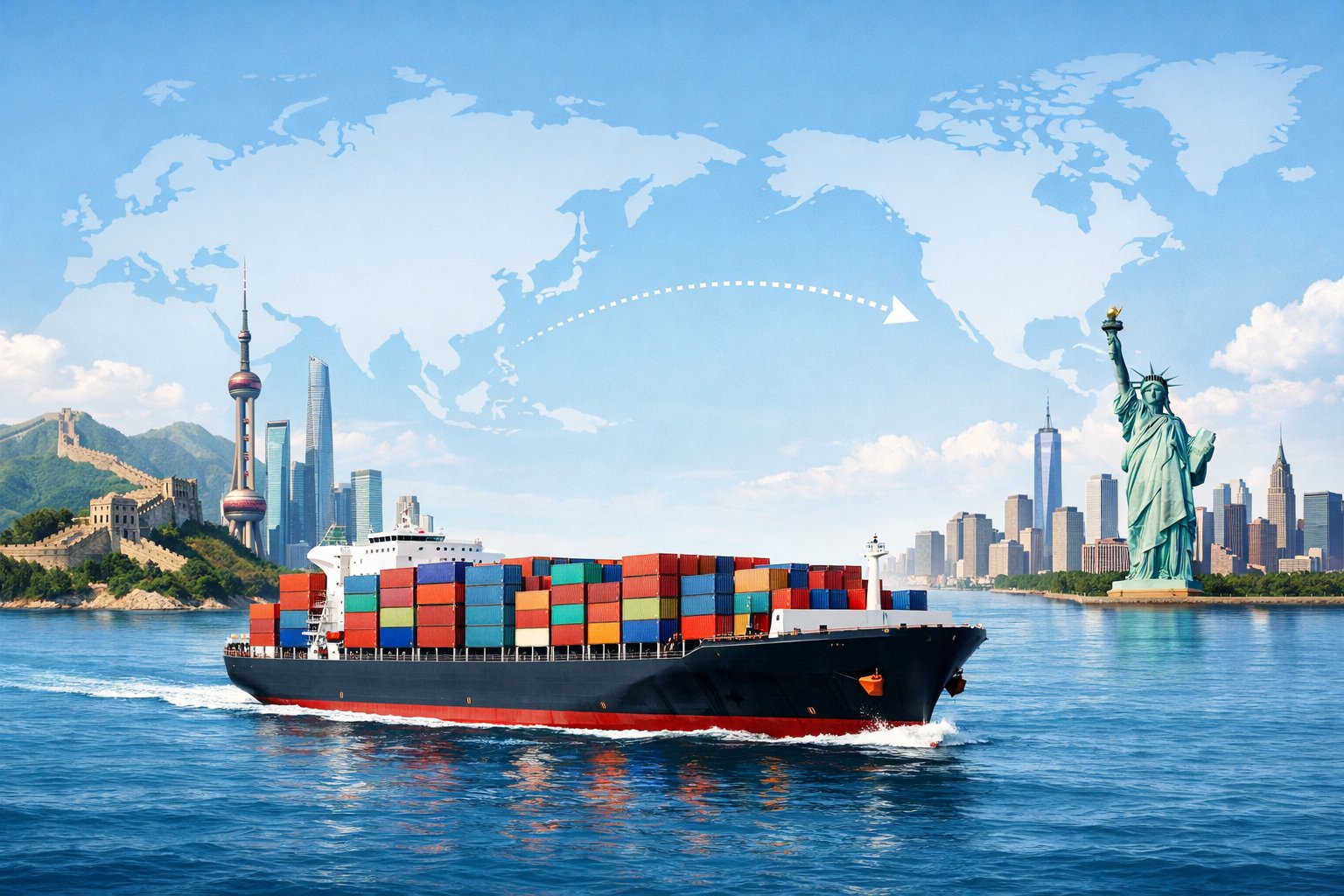
Shipping Freight from China to US: Methods, Costs & Essential Guide
📅 December 25, 2025
Shipping freight from China to US is a challenge every importer faces. The process involves picking the best method, managing costs, and dealing with regulations that keep changing.
Shipping freight from China to US usually costs $382 per cubic meter for less-than-container loads by sea, or $7.54-$9.54 per kilogram for express air shipping. Transit times range from 2-5 days for express service to 30-40 days for ocean freight, so your choice really depends on your budget, timeline, and cargo size.
Understanding the shipping process can help you avoid delays and unexpected fees. Tariff changes now mean duties on Chinese goods have dropped from 125% to 30% through August 2025.
But parcels under $800 face a 30% base tax and extra handling fees. You’ll need to know the right customs paperwork, how to pick between air and sea, and which freight forwarders really know the China-US lane.
This guide covers up-to-date shipping costs, realistic delivery times, and practical tips for getting your goods across the Pacific efficiently. Let’s dig into how to choose the right method, manage customs, and partner with freight forwarders who actually get the job done.
Key Takeaways
- Sea freight costs $3,640-$7,600 per container and takes 30-40 days, while air freight costs $4-$9.54 per kilogram and delivers in 2-10 days.
- Current US tariffs on Chinese goods are 30% for most products, with parcels under $800 subject to base tax plus handling fees.
- Choosing a China-based freight forwarder with strong US customs clearance helps avoid delays and reduces shipping complications.
Shipping Methods from China to US
When shipping freight from China to the US, you get four main options, each with its own speed, cost, and cargo capacity. Ocean freight is ideal for big shipments, air freight balances speed and volume, express shipping handles urgent small parcels, and multimodal transport mixes methods for the best route.
Ocean Freight Shipping Freight from China to US
This is the go-to for container shipping, especially if you’ve got a lot to move and want lower costs. There are two main choices here, and it really comes down to how much you’re shipping.
FCL shipping means you take the whole container. A 20-foot container costs $1,800 to $3,000 to the West Coast, and a 40-foot runs $2,500 to $4,200. FCL makes sense if you’re filling most of the container.
LCL shipping lets you split a container with others, paying only for your share. Rates are usually $40 to $80 per cubic meter. It’s a solid option for smaller shipments that don’t fill a container.
Transit times for ocean freight are 15 to 25 days to the West Coast, 25 to 35 days to the East Coast. Add another 3 to 7 days for customs and final delivery.
Air Freight Shipping Freight from China to US
Air freight gets your goods there much faster than ocean, and it can handle bigger loads than express couriers. Standard air freight costs about $5 to $8 per kilogram, with minimum charges starting around $100 to $200.
Flights from China to the US take 3 to 6 days. With customs and ground transport, you’re looking at 5 to 10 days total.
This method is great for medium-weight shipments when you need speed but don’t need the absolute fastest service. It’s especially useful for restocking, seasonal items, or goods that can’t wait too long.
Air freight charges use actual or volumetric weight—whichever’s higher. Volumetric weight is length × width × height (cm), divided by 6,000.
Express Shipping Freight from China to US
Express shipping is the fastest way to move goods from China to the US, with carriers like DHL, UPS, and FedEx handling everything. Delivery takes just 2 to 5 business days, door-to-door.
Express delivery runs $8 to $15 per kilogram, with minimums from $25 to $50. It’s pricier, but you get speed and convenience.
This option includes customs clearance, tracking, and delivery right to your address. The carriers handle the paperwork and logistics, so it’s perfect for urgent shipments.
Express shipping is best for samples, documents, small parcels, and anything time-critical. Most shipments fall between 1 and 100 kilograms.
Multimodal Shipping Freight from China to US
Multimodal transport mixes two or more shipping methods to balance cost and delivery time. Often, you’ll see ocean freight for the main journey and trucks for inland delivery.
Door-to-door shipping is the full package, with your freight forwarder handling everything from pickup to delivery. They sort out export, transport, customs, and final drop-off at your warehouse.
This service costs $12 to $20 per kilogram for air-based routes, or uses container rates for sea. Delivery takes 8 to 15 days by air, or 30 to 40 days by sea.
You don’t have to juggle multiple carriers or brokers. One provider coordinates the lot and gives you a single point of contact.
Shipping Freight from China to US: Costs and Freight Rates
Shipping costs from China to the US depend on your transport mode, cargo size, weight, and the ever-changing market. Ocean freight gives you the lowest rates for bulk, while air freight is faster but pricier.
Factors Affecting Shipping Freight from China to US
Your shipping cost from China to the USA depends on several main things. Cargo weight and size determine if you pay by actual or volumetric weight. Heavy, compact items usually cost less per kilogram than light, bulky ones.
Which ports you use also affects your freight rates. Shipping from Shanghai to Los Angeles is cheaper than sending to New York or Savannah. Cargo type matters too—hazardous, refrigerated, or oversized shipments cost more.
Prices spike in peak seasons, especially August through October. Fuel costs, port congestion, and carrier space can also change rates month to month.
Choosing port-to-port or door-to-door service affects your total cost. Door-to-door adds customs and inland delivery for convenience, but it’s pricier.
Comparing Ocean and Air Freight Rates for Shipping Freight from China to US
Sea freight costs run $2 to $4 per kilogram for most cargo. A 20-foot container is about $1,200 to $2,500, while a 40-foot runs $1,800 to $3,800. Ocean freight is your best bet for big or heavy loads if you can wait.
LCL (Less than Container Load) shipping charges $35 to $65 per cubic meter. It’s good for 1 to 12 cubic meters of cargo. FCL (Full Container Load) gives you better value when you can fill the container.
Air freight rates are $4.50 to $8.50 per kilogram for standard service. You pay by chargeable weight—actual or volumetric, whichever’s higher. Airlines use length × width × height divided by 6000 to figure it out.
Air costs more but gets your goods there in 3 to 7 days, compared to 20 to 40 by sea. That speed is worth it for urgent orders or high-value goods.
Express and Courier Pricing for Shipping Freight from China to US
Express courier services like DHL, UPS, and FedEx charge $6.50 to $12.50 per kilogram. They get your shipment there in 2 to 5 days, handling customs and tracking along the way.
Couriers stick to volumetric weight rules, so light but bulky packages can cost a lot. Remote deliveries add extra fees, too.
DDP (Delivered Duty Paid) air freight costs $7.50 to $12.00 per kilogram, covering customs, taxes, and final delivery. You know your total cost upfront—no surprise customs bills.
Express shipping is really for samples, small batches, or anything that can’t wait. The higher price makes sense if speed and reliability are more important than saving a few bucks.
Tips for Cutting Shipping Freight from China to US Costs
Combine small shipments into bigger ones to lower your per-unit shipping costs. Filling a whole container always beats LCL rates. Ship during off-peak months for better prices and more space.
Pick the right freight solution for your schedule. Use sea freight if you’ve got 4 to 6 weeks. Save air freight for true emergencies—otherwise, you’ll just pay extra for nothing.
Work with a savvy shipping agent who can get you better rates and options. They’ll have access to volume discounts and know which carriers are best for your route. Always compare a few quotes before you commit.
Smaller, tighter packaging cuts down on volumetric weight for air shipments. Getting your HS codes right also keeps customs simple and duty rates accurate.
Shipping Freight from China to US: Transit Times and Delivery Schedules
Shipping times from China to the US can swing widely, depending on your method and route. Ocean freight usually takes 18-40 days, while air freight can land in under a week. Both can hit delays from customs or port congestion.
Typical Ocean and Air Transit Times for Shipping Freight from China to US
Sea freight times depend on your ports. West Coast cities like Los Angeles or Long Beach get shipments in 18-25 days. East Coast ports—think New York or Savannah—take 30-40 days, since ships go farther or through the Panama Canal.
Air freight transit is much quicker. Express air delivers in 1-3 days, while standard air takes 5-8 days from China to US hubs. Don’t forget to add ground transport, customs clearance, and any warehouse time to your total shipping time.
The freight time from China to US is always a trade-off between cost and urgency. Sea freight is way cheaper per kilogram, but you need to plan ahead. Air freight is best for high-value, urgent, or short-shelf-life products.
Direct vs. Indirect Shipping Routes: China to USA Transit Time
When you look at shipping routes from China to the USA, direct routes connect Chinese ports straight to US destinations without any stops. These direct options usually save you 3-7 days compared to indirect shipping routes.
Major carriers run direct services from Shanghai, Shenzhen, or Ningbo to Los Angeles. If you want the most reliable china to usa transit time, direct routes are hard to beat.
Indirect routes involve transshipment stops in ports like Busan, Hong Kong, or Singapore. Your cargo gets transferred between vessels at these hubs, which adds time and a few extra headaches.
Sometimes, indirect routes offer lower rates or reach smaller US ports that don’t have direct connections. So, there’s a trade-off between speed and flexibility.
The main shipping routes from China to USA follow set paths across the Pacific. Choosing between direct and indirect shipping changes both your timing and risk profile.
Direct routes cut down on handling points where delays or damage could pop up. That’s a big plus if you’re shipping delicate or high-value goods.
Factors Delaying China to USA Transit Time
Port congestion continues to mess with shipping schedules. US West Coast ports sometimes get backed up for 5-10 days, especially during peak seasons or labor disputes.
Equipment shortages, limited dock space, and not enough staff all pile onto these bottlenecks. It can feel like you’re waiting forever for your container to get unloaded.
Customs delays can throw your timeline off, too. Incorrect paperwork, missing info, or random inspections might hold your cargo for days—or even weeks.
Your HS codes have to match your goods, and every commercial invoice needs to be spot-on. Even a small mistake can slow things down.
Weather disruptions are another wildcard. Typhoons in Asia and hurricanes along US coasts sometimes force port closures and reroute ships.
Holiday periods like Chinese New Year shut down factories and reduce vessel availability for weeks. The ripple effect stretches through global supply chains.
How to Accelerate China to USA Transit Time
You can speed up customs clearance by preparing all your documents before the shipment lands. If you work with experienced customs brokers, they’ll know the rules and fix issues fast.
Pre-clearing goods through programs like C-TPAT can shave off precious time. It’s worth considering, especially for high-value or urgent shipments.
Pick less congested ports when you can. Oakland, Seattle, or Tacoma sometimes move cargo faster than Los Angeles during crunch times.
Your freight forwarder can help you find alternative routes that dodge known slowdowns but still keep costs reasonable. It’s not always obvious, so ask for their advice.
Book your space early if you’re shipping during peak season—August through October is especially busy. Carriers tend to prioritize customers with advance reservations and steady volume.
Premium services like guaranteed space or priority unloading do cost more. But if you need reliable shipping time from China to USA for a product launch, it’s money well spent.
Customs Clearance and Regulatory Compliance for China to USA Transit Time
If you’re shipping freight from China to the U.S., you need to navigate customs clearance and stick to import rules. Knowing how duty calculations, documentation, and bond requirements work helps your cargo clear U.S. Customs and Border Protection without costly delays.
Import Duties and Taxes for China to USA Transit Time
You’ll pay import duties and taxes based on your product’s classification and declared value. U.S. Customs uses HS codes to figure out the tariff rate for every item you import.
HS codes are standardized numbers that identify what you’re shipping. If you use the wrong code, you could end up overpaying, underpaying, or getting stuck in customs.
It’s a good idea to double-check your products’ HS codes before shipping. Getting it right saves time and money.
Besides tariffs, you’ll pay a Merchandise Processing Fee (MPF) and maybe a Harbor Maintenance Fee (HMF) for ocean shipments. The MPF usually runs about 0.3464% of your shipment’s value, with set minimums and maximums.
Some Chinese products even face anti-dumping duties. It’s not common, but it’s something to watch for.
A licensed customs broker can help you calculate your total landed costs and make sure you’re using the right codes and paying the right fees.
Key Shipping Documentation for China to USA Transit Time
Your customs clearance from China to the USA needs a few must-have documents. The commercial invoice lays out details about your goods—quantity, value, payment terms, all that.
The bill of lading is your contract with the carrier and proof you shipped the goods. Ocean freight gets a Bill of Lading (B/L), while air shipments use an Airway Bill (AWB).
This paperwork lets you track your cargo and proves you own it. You’ll also need a packing list showing how your goods are packaged, including weight, dimensions, and what’s in each container.
The Certificate of Origin proves where your products were made and can get you preferential tariffs. Depending on what you’re importing, you might need extra permits or certifications.
FDA-regulated products, electronics, and some consumer goods require special clearance. It’s not always obvious, so double-check before you ship.
Customs Bonds and Entry Requirements for China to USA Transit Time
You need a customs bond to guarantee payment of duties and taxes to U.S. Customs. A single entry bond covers one shipment and costs about $50-$150, depending on your cargo’s value.
If you import regularly, a continuous bond makes more sense. It stays active for a year and covers unlimited shipments during that time.
For ocean shipments, you must file an Importer Security Filing (ISF) at least 24 hours before your cargo leaves China. Sometimes you’ll need an ISF bond to cover penalties for late or inaccurate filings.
Miss the ISF deadline and you’re looking at fines starting at $5,000 per violation. Most importers let a customs broker handle entry requirements and bond procurement.
Your broker files documents through the Automated Commercial Environment system and keeps you compliant with CBP rules.
Major Shipping Routes and Port Infrastructure for China to USA Transit Time
The journey from China to the US depends on established ports and shipping lanes that move billions in trade every year. Which port and route you choose impacts your shipping costs, transit time, and supply chain headaches.
Key China and US Ports for China to USA Transit Time
Shanghai Port leads the world in shipping and is the main gateway for exports to the US. It handles the most container traffic globally and offers top-notch infrastructure.
Shenzhen Port is the go-to for electronics and manufactured goods. It sits close to southern China’s factory hubs, making it super convenient for many shippers.
Other major Chinese ports for export include:
- Ningbo-Zhoushan – A fast-growing port with modern facilities
- Guangzhou Port – Efficiently serves inland factories
- Qingdao Port – Connects to northern China manufacturing
On the US side, West Coast ports receive most shipments from China. The Port of Los Angeles and Port of Long Beach together form the biggest port complex in North America.
These two handle about 40% of all US imports from China. The Port of Oakland is another major West Coast entry point and usually has less congestion than Southern California ports.
East Coast ports like New York-New Jersey, Savannah, and Charleston are alternatives for shipping routes from China to the USA. They take longer to reach, but sometimes it’s worth it for the smoother process.
Popular Shipping Lanes for China to USA Transit Time
The Trans-Pacific Route connects Chinese ports directly to West Coast destinations. This lane usually takes 11 to 23 days, making it the fastest ocean freight option.
The Panama Canal Route takes longer—26 to 47 days—but lets ships reach East Coast ports without extra domestic transport. If your goods are headed east, you might save on inland shipping costs.
Your choice of key shipping routes from China to USA depends on your final destination and how fast you need your goods.
Port Infrastructure Challenges for China to USA Transit Time
Port congestion still causes plenty of headaches at major US facilities. The Port of Los Angeles and Port of Long Beach see regular delays during peak times, which can tack on days or even weeks to your delivery.
Port infrastructure struggles include:
- Not enough berth space for big ships
- Limited warehouse capacity near ports
- Truck driver shortages for inland hauls
- Older cargo handling equipment
These issues raise your costs and complicate planning. You’ll want to build a buffer into your shipping schedule and consider other ports during busy seasons.
Some importers choose East Coast ports to skip West Coast congestion, even if the ocean transit takes longer. Sometimes it’s just less stressful that way.
Freight Forwarders, Logistics, and Specialized Services for China to USA Transit Time
Freight forwarders play a huge role in managing complex shipping routes and paperwork between China and the US. They offer specialized services like door-to-door delivery and cargo insurance, making the whole process a lot smoother.
Role of Freight Forwarders in China to USA Transit Time
A freight forwarder organizes shipments from your manufacturer in China to your final stop in the US. They coordinate logistics, shipping routes, and work with multiple carriers to get your goods delivered.
Freight forwarding companies handle export paperwork, customs clearance, and import rules for you. They book space with carriers like Air China Cargo, Cathay Pacific, Delta, and various ocean lines.
Big global names include DHL, DB Schenker, and Expeditors International. Your forwarder will coordinate everything—trucking from the factory to the port, ocean or air freight across the Pacific, and final delivery to your warehouse.
Some forwarders, like China-US Freight, focus only on the China-to-US route. That kind of specialization can make a difference if you’re shipping regularly.
Door-to-Door and Amazon FBA Shipping for China to USA Transit Time
Door-to-door service means your freight forwarder takes care of everything from pickup at the Chinese factory to delivery at your US address. They handle carrier booking, customs, port handling, warehousing, and inland trucking.
Complete door-to-door international freight forwarding saves you from juggling multiple vendors. Companies like Tonlexing even offer DDP (Delivered Duty Paid) shipping, so all costs and risks pass to you at your door.
Shipping to Amazon FBA? You’ll need special prep and labeling. Forwarders with FBA experience handle inspection, labeling, and direct delivery to Amazon fulfillment centers, plus all the documentation Amazon wants.
Express freight options through FedEx, DHL, and UPS are great for urgent shipments. If you want to cut costs, consolidated air freight lets you share space with other shippers on the same flight.
Cargo Insurance and Risk Management for China to USA Transit Time
Cargo insurance protects your shipment from loss or damage during the trip from China to the US. Risks include weather, handling accidents, theft, and vessel incidents—stuff you can’t always predict.
Standard carrier liability only covers a tiny amount per kilogram or pound. It’s almost never enough to cover your cargo’s real value.
Marine cargo insurance usually costs between 0.3% and 1.5% of your shipment’s value. The rate depends on what you’re shipping, the route, and the transport mode.
Higher-risk goods or destinations cost more to insure. Your freight forwarder can set up cargo insurance as part of their logistics package.
Some forwarders include basic coverage, but you can always add more if you need it. It’s worth asking about, especially if you’re shipping high-value products.
About AEB Logistics
AEB Logistics stands out in the world of freight forwarding between China and the United States. They focus on air freight, ocean freight, and express courier services for businesses importing goods from China.
AEB Logistics also handles customs brokerage, warehousing, and distribution across the US. You can choose between full container loads or less-than-container shipments, depending on your needs.
They’ve put tracking systems in place so you can keep an eye on your cargo through every step of the journey. The company partners with big names like Air China, Cathay Pacific, and global couriers such as UPS and FedEx.
Their logistics solutions cover regular commercial goods and specialized cargo that might need temperature control or extra-fast delivery. This flexibility makes them a solid choice for a range of shipping needs.
Frequently Asked Questions: Shipping Cost from China to USA
Shipping costs depend on weight, volume, and how you choose to ship. Most shipments run between $3 and $5 per kilogram, whether you pick air freight or express services.
What are the current rates for Shipping Cost from China to USA?
Rates change all the time based on your method and the size of your shipment. Express freight usually costs about $5 per kilogram for packages and small shipments up to 150 kg.
Air freight averages around $3 per kilogram for standard service. This price fits best for shipments weighing between 150 kg and 500 kg.
With ocean freight, you pay a flat rate per container, not by weight. A full 20-foot or 40-foot container has one price, no matter how full it is.
How is Shipping Cost from China to USA calculated per kilogram?
Your per-kilogram rate comes down to your shipment’s actual weight versus its dimensional weight. Carriers figure out dimensional weight by multiplying length, width, and height, then dividing by a set number.
They charge you based on whichever is higher—actual or dimensional weight. So, really light but bulky items might cost more than you’d expect from their weight alone.
Express services sit at the top end, charging around $5 per kg. Air freight lands in the middle at about $3 per kg for most standard shipments.
What are the cost differences between air and sea Shipping Cost from China to USA?
Air freight costs more per kilogram but gets your goods there much faster. Standard air freight is about $3 per kg, with delivery usually in 8 to 10 days.
Ocean freight turns into the cheapest option when your shipment goes over 500 kg. Sea shipping takes longer—think 30 to 40 days—but you’ll save a lot on big shipments.
The price gap gets bigger as your load grows. For example, a 1,000 kg shipment might cost $3,000 by air, but only $800 to $1,500 by sea, depending on the container you pick.
What factors influence Shipping Cost from China to USA for containers?
Your container shipping cost depends on the container’s size, where it starts and ends, and what’s happening in the market. A 20-foot container costs less than a 40-foot one, but you only get about half the space.
Popular shipping routes, like Shanghai to Los Angeles, often have better rates than less common ports. Prices go up during peak seasons since demand jumps.
Fuel prices, port congestion, and even weather can change your final rate. Tariffs and trade policies sometimes add surprise costs, so it’s smart to double-check before booking.
How can you find the cheapest Shipping Cost from China to USA?
Comparing several freight forwarders is the best way to spot lower rates. Prices shift a lot between providers and can change quickly with supply and demand.
Express shipping makes sense for small packages under 150 kg. Air freight starts to look better for shipments between 150 kg and 500 kg.
Once you go over 500 kg, ocean freight usually gives you the lowest per-kilogram cost. Booking FCL instead of LCL is a good move around 15 cubic meters, since full containers cost less per cubic meter.
Why Is Shipping from China to the USA Cheaper Than You’d Think?
Shipping from China to the USA often surprises people with its affordability. The main reason? Ocean freight unlocks huge economies of scale.
Modern cargo ships can haul up to 20,000 twenty-foot containers. That sheer volume lets carriers spread out costs across countless shipments.
If you don’t have enough cargo to fill a container, LCL (less-than-container load) service steps in. It lets you consolidate your goods with others, so you only pay for the space you use.
Honestly, that’s a game-changer for small businesses or anyone shipping lower volumes.
Working with experienced freight forwarders makes a real difference too. They help you dodge expensive mistakes with paperwork and customs headaches.
Plus, their shipping volume and long-standing carrier relationships mean they can often negotiate better rates than you’d get on your own.
Ready to Ship from China to USA?
Get a free quote from our logistics experts today.
Get a Free Quote →