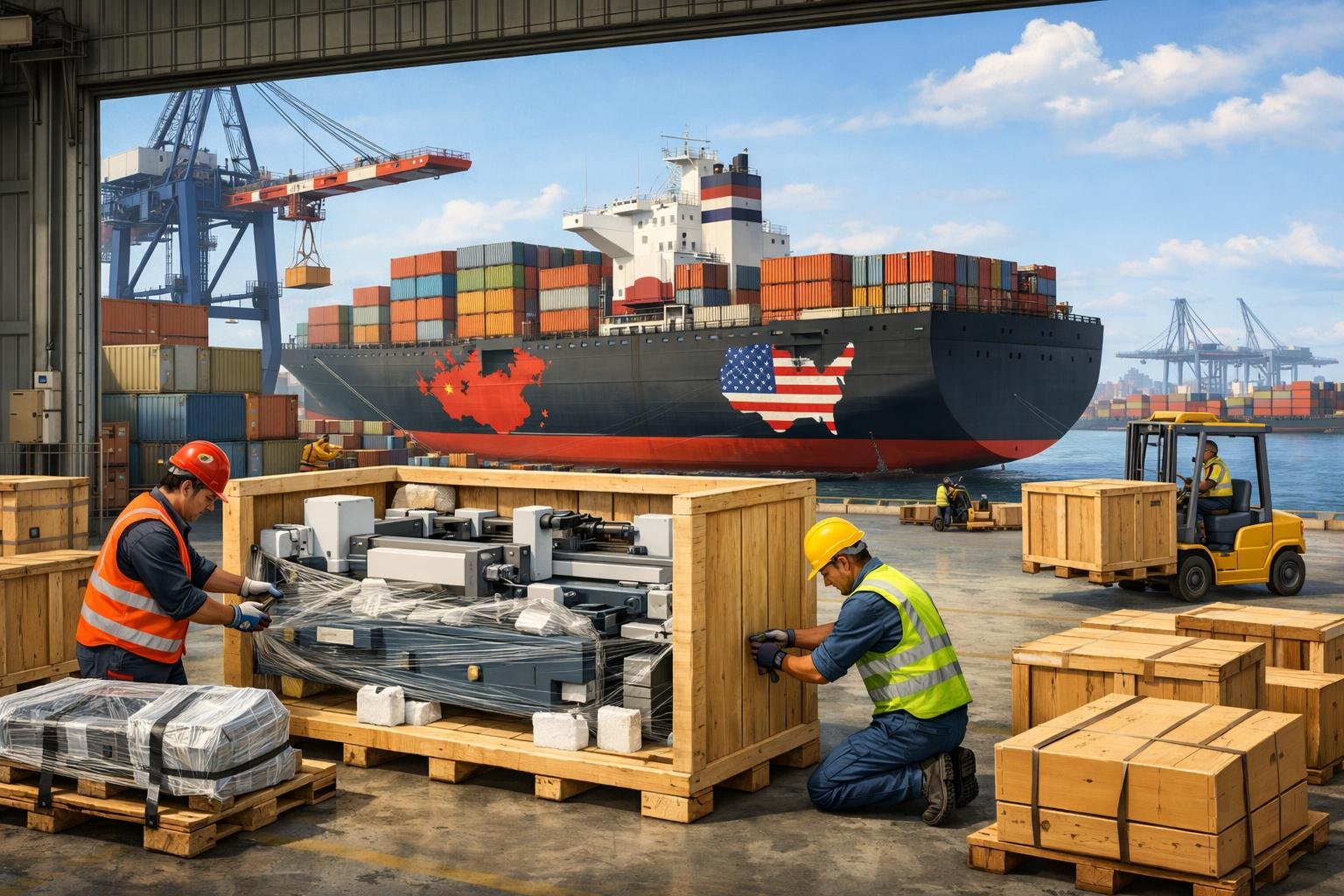
Woodworking Machine Shipping China to USA: Complete Guide for Importers
📅 April 09, 2026
If you’re looking at woodworking machine shipping China to USA, there’s a lot more to it than just booking a spot on a cargo ship. You have to figure out shipping methods, customs paperwork, packaging, and, honestly, you’ll want a freight forwarder who actually knows what they’re doing.
Sea freight is the most cost-effective option for woodworking machine shipping China to USA. Container shipping usually runs between $1,500 and $2,800, with transit times of 25 to 40 days.
The right shipping method—full container load, less than container load, or something specialized—depends on your equipment’s size and weight. CNC machines, table saws, and other woodworking gear need solid crating and proper securing so nothing gets banged up during the ocean voyage.
Good packaging protects your investment and helps you dodge customs delays. Working with experienced freight forwarders who handle machinery shipping from China really takes the edge off. They’ll help with paperwork, customs, and getting your machinery where it needs to go.
Key Takeaways
- Sea freight gives you the best mix of price and reliability for woodworking machine shipping China to USA.
- Sturdy packaging—think wooden crates and moisture protection—keeps your machines safe and helps clear customs faster.
- Freight forwarders who know machinery can handle the paperwork and compliance, so your gear shows up safely and on time.
Shipping Methods for Woodworking Machinery from China to USA
When it comes to woodworking machine shipping China to USA, ocean freight is usually the cheapest. Air freight and express services get your gear there faster, but you’ll pay a premium. Your choice depends on the size, weight, and how quickly you need your machines.
Sea Freight (FCL and LCL)
Sea freight is the go-to for most woodworking machine shipping China to USA. You’re looking at $1,500 to $2,800 for a container, with 25 to 40 days on the water depending on the port.
With Full Container Load (FCL), you get the whole container to yourself. A 20-foot container fits up to 28 tons, and a 40-foot one holds up to 32 tons. FCL makes sense if your shipment is over 15 tons or you have a few machines going at once.
Less Than Container Load (LCL) lets you split space with others. It’s cheaper for single machines under 10 tons or if you’re just sending parts. LCL usually adds 3 to 7 extra days because of extra handling at warehouses.
Container options for woodworking machinery:
- 20-foot standard: 19’4″ × 7’8″ × 7’10”
- 40-foot standard: 39’5″ × 7’8″ × 7’10”
- 40-foot high cube: 39’5″ × 7’8″ × 8’10”
Air Freight Solutions
Air freight gets your woodworking machines from China to the USA in 3 to 7 days, but the cost is 5 to 10 times higher than ocean freight. Airlines charge based on whichever is higher—actual weight or dimensional weight.
Cargo planes can handle up to 20 tons, but size limits are tight. Air freight is best for urgent parts, small precision equipment, or high-value machinery that fits the restrictions.
Major cargo airports like Los Angeles, JFK, and Chicago O’Hare handle most woodworking machine shipping China to USA. Your freight forwarder can help coordinate the pickup and final delivery.
Honestly, only use air freight if delays would cost you more than the shipping price. Sometimes you just can’t wait, and that’s when it’s worth it.
Express Courier Services
Express shipping with DHL, FedEx, or UPS gets your stuff there in 2 to 5 days, door-to-door. Customs clearance and tracking are included.
Each package is limited to 150 pounds, and size limits depend on the carrier. Express is great for small woodworking tools, replacement parts, or accessories you need in a hurry.
Best uses for express shipping:
- Spare parts under 150 lbs
- Small tools and components
- Urgent replacement equipment
- Items needing fast customs clearance
It costs more per pound, but the speed and convenience can be worth it when you’re in a pinch.
Multimodal and Rail Transport Options
Multimodal shipping mixes and matches methods to balance cost and speed. Maybe you send the main shipment by sea freight and urgent parts by air.
Rail from West Coast ports can save money on inland delivery. Trains move containers from Long Beach or similar ports to inland cities for less than trucks.
Common multimodal combos:
- Ocean freight + truck for the last leg
- Air freight + truck for inland delivery
- Sea freight + rail for cross-country moves
- Express + truck for last-mile drop-off
Your freight forwarder connects all these dots. They’ll keep tabs on your woodworking machinery at every stage.
Packaging and Handling Requirements
For woodworking machine shipping China to USA, you need packaging that can handle ocean transport and meet carrier rules. Proper crating, clear paperwork, and insurance all work together to get your machines there in one piece.
Safe Packing for Large and Delicate Machinery
Get your machines ready before shipping. Clean off any debris, grease, or sawdust. Drain fluids from hydraulics and oil up the metal parts to keep rust away during the ocean trip.
If you can, disassemble big machines to save space and money. Take off extensions, blade guards, and loose parts. Wrap every piece in bubble wrap or foam, and label everything so you can put it back together later.
Lock down all moving parts to prevent vibration damage. Use factory restraints or custom bracing to keep motors and belts in place. Anchor doors and panels so nothing shifts and breaks.
Using Wooden Crates and Dimensional Weight Considerations
Wooden crates are your best bet for keeping woodworking machinery safe during international shipping. Build crates with strong internal bracing to support the machine’s weight. Make sure the crate can stand up to stacking and forklifts.
Dimensional weight matters as much as actual weight. Carriers calculate it by multiplying length × width × height (in inches) and dividing by 166 for ocean freight. You’ll pay for whichever is higher.
Your packing list needs to have all the measurements and weights for customs. List crate sizes, gross and net weight, and what’s inside. Customs officers use this to check your shipment and figure out duties.
Put waterproof barriers between the machine and crate walls. Toss in some desiccant packs to keep moisture under control during the trip.
Cargo Insurance and Damage Prevention
Cargo insurance is a must. Standard coverage is only $0.50 per pound, which won’t replace expensive woodworking machines. Go for all-risk marine cargo insurance that covers the full value.
Insurance companies want to see complete shipping documentation—commercial invoice, packing list, and bill of lading. Take photos before you crate the machine and after loading. If you need to file a claim, those photos are your proof.
Pick carriers who know how to handle industrial equipment. Make sure the loading crew uses the right gear and secures your crates with proper straps and blocking. Don’t rush the process—careful handling is worth the extra day or two.
Shipping Costs, Rates, and Delivery Times
Shipping costs for woodworking machine shipping China to USA depend on weight, size, and how you ship. Sea freight usually runs $1,500 to $2,800 per container and takes 25 to 40 days. Air freight is much faster at 3 to 7 days, but it’s way more expensive.
Factors Affecting Shipping Costs
Weight and dimensions are the biggest factors in your shipping rate. Heavy gear like table saws and planers costs more than small tools.
The shipping method makes a big difference. Sea freight is the most cost-effective option for large woodworking machines. Air freight costs a lot more but gets your equipment there fast.
Main cost factors:
- Machine weight and volume
- Fuel surcharges
- Port fees
- Insurance premiums
- Seasonal demand
Rates go up during peak shipping season (August to October). Winter is usually cheaper.
Container type matters too. A 20-foot container holds up to 28 tons, while a 40-foot can handle 32 tons. If your equipment is oversized, you might need a flat rack container, which costs extra.
Estimating Shipping Rates and Transit Times for Woodworking Machine Shipping China to USA
Woodworking machine shipping China to USA is a big project, and getting the shipping rates and transit times right matters a lot. Sea freight transit times vary between 20-45 days depending on your destination port.
West Coast ports like Los Angeles usually get shipments faster than East Coast locations. If you’re in a hurry, that’s something to keep in mind.
You can calculate shipping costs using online rate tools by entering your machine’s weight, dimensions, and destination. Most freight forwarders can give you free quotes within 24 hours.
Typical delivery timelines:
Shipping Method Transit Time Cost Range Sea Freight (FCL) 25-40 days $1,500-$2,800 Air Freight 3-7 days 5-10x sea rates Express Courier 2-5 days Highest cost Your total delivery timeline includes ocean transit plus customs clearance. You’ll need to add 3-5 days for U.S. customs processing and documentation review.
Inland Trucking and Door Delivery Options
Once your woodworking machine arrives in the USA, you still need to get it from the port to your facility. Inland trucking adds some days to your total timeline.
Ground transportation is required whether you ship by sea or air. It’s just part of the deal.
Door-to-door delivery services can handle the whole journey from the Chinese factory to your workshop. This option costs more, but it takes a lot of stress off your plate.
Inland delivery options:
- Port pickup: You arrange your own trucking (lowest cost)
- Terminal delivery: Carrier delivers to nearest terminal
- Door-to-door: Complete delivery to your address
Rail transport from West Coast ports can lower inland costs for long-distance shipments. Most people still use trucks for the final leg to their shop.
Heavy woodworking machines need special equipment like flatbed trucks or liftgate service. Make sure your receiving dock can handle large trucks and that you have a safe way to unload the machinery.
Customs Clearance and Import Regulations
Woodworking machine shipping China to USA means dealing with customs clearance, paperwork, and U.S. import rules. You’ll need the right documents, pay duties and tariffs, and follow all US Customs regulations.
Work with a customs broker, know the Harmonized Tariff Schedule, and understand your responsibilities as the importer of record. It’s a lot, but it’s doable.
Essential Shipping Documentation
You’ll need several documents to clear woodworking machinery through US customs. The commercial invoice lists your shipment’s description, quantity, value, and seller details.
This invoice helps customs officials figure out the correct duty rates. The bill of lading acts as your shipment receipt and proof of ownership.
It includes info about the transport method, shipping route, and delivery details. You’ll also need a packing list with the contents, dimensions, and weight of each package.
A certificate of origin shows where your equipment was made and if it qualifies for special duty rates. Sometimes, you’ll need to provide safety certifications or maintenance records, especially for used machinery.
These documents prove your equipment meets US safety standards set by OSHA.
US Customs, Duties, and Section 301 Tariffs
When you import woodworking machinery from China, you’ll face several fees. Import duties depend on the Harmonized System classification code for your equipment.
Most agricultural equipment enters duty-free, but woodworking machines usually have their own duty rates. Section 301 tariffs can add extra costs to Chinese imports.
These tariffs hit certain product categories and can make your total import bill much higher. Always check if your machine falls under Section 301 coverage.
Standard Import Fees:
- MPF (Merchandise Processing Fee): 0.3464% of cargo value (minimum $27.75, maximum $538.40)
- HMF (Harbor Maintenance Fee): 0.125% of cargo value for ocean shipments
- Import duties: Varies by product classification
- Section 301 tariffs: Additional percentage if applicable
Calculate these fees using your machinery’s declared value. That means the equipment cost plus shipping and insurance.
Role of Licensed Customs Brokers
A licensed customs broker can handle customs clearance procedures for you. They know the regulations and help you avoid mistakes.
Brokers classify your machinery with the right tariff codes, which sets your duty rates. If you get the code wrong, you could face penalties or shipment delays.
They also calculate all the fees—MPF, HMF, Section 301 tariffs—and talk to customs during inspections. Working with a good broker lowers your risk of shipment holds or rejections.
Harmonized Tariff Schedule and Importer of Record Responsibilities
The Harmonized Tariff Schedule (HTS) has over 17,000 product codes. Your machine’s HTS code decides the duty rate.
Woodworking equipment uses different codes based on function, power, and features. As the importer of record, you’re legally responsible for the shipment.
You must make sure all documentation is accurate and follow US import rules. This includes getting the value right, using the correct tariff code, and paying all duties and fees.
Keep records of your imports for five years. US Customs can audit you at any time.
False declarations or misclassification can mean penalties, seized goods, or even criminal charges. Also, check that your imported machinery meets US safety and environmental standards, or customs might reject it.
Choosing a Reliable Freight Forwarder or Shipping Partner
Woodworking machine shipping China to USA is smoother with the right partners. You need people who understand heavy cargo, know the paperwork, and can handle US customs for commercial imports.
Your freight forwarder, customs broker, and delivery provider all play a role in getting your equipment delivered safely and legally.
Selecting an Experienced Freight Forwarder
Your freight forwarder manages the shipping process from the Chinese factory to your US site. Pick companies with real experience moving heavy machinery and oversized cargo.
Woodworking equipment often needs special containers and extra securing. Make sure your forwarder has a valid Federal Maritime Commission license for ocean freight.
Check their legitimacy to avoid scams and hidden fees. Ask for detailed quotes that break down every charge.
A good quote covers origin charges, freight costs, destination fees, and fuel surcharges. It’s smart to compare at least three forwarders using the same shipment info.
See if they offer cargo insurance for machinery. Woodworking machines are expensive and can be damaged if not handled right.
Your forwarder should also give you real-time tracking so you know where your shipment is during the 25-40 day ocean transit.
Working with Customs Brokers
A licensed customs broker handles your import paperwork and gets your machinery through US customs. They classify your woodworking equipment with the right HTS codes, which sets your duty rates.
Your broker prepares the customs entry and submits required documents like the invoice, packing list, and bill of lading. For industrial machinery, they also check that you meet safety standards.
Many freight forwarders offer customs brokerage as part of their package. This makes things easier since one company handles both shipping and clearance.
Ask if customs fees are included in your quote or if they’re billed separately.
Comparing Global Delivery Providers
DHL, FedEx, and UPS offer door-to-door service for smaller woodworking tools and parts. They’re fast and have good tracking systems.
For full-size machinery, you’ll probably need specialized freight services. DHL and UPS have freight divisions for palletized and crated equipment. FedEx Freight handles heavy shipments that need liftgate delivery.
Compare transit times and costs between air and ocean:
**Method** **Transit Time** **Best For** Air Freight 5-10 days Urgent orders, lightweight tools Ocean FCL 25-40 days Full machines, cost-sensitive shipments Pick your provider based on your delivery deadline and budget. Sometimes, the cheapest isn’t the best fit.
Special Considerations for CNC and Woodworking Machinery
CNC machines and woodworking equipment need extra care during import. They’re sensitive, have precise parts, and must meet strict U.S. safety standards.
New machinery follows different customs rules than used equipment. Your paperwork must show exact specs to avoid inspection delays.
Importing CNC Machines from China
CNC machine shipping from China to USA needs the correct HTS code on your commercial invoice. Most CNC woodworking machines use code 8457.10, while routers and carving machines might use 8465.95.
File an Importer Security Filing (ISF) at least 48 hours before your machine loads onto the vessel. Miss that deadline, and you could face $5,000+ in penalties.
Your invoice must list the machine’s exact weight, power, voltage, and model number. These details should match the equipment nameplate perfectly.
If customs spots a mismatch, they’ll order a physical inspection. That can delay delivery by two weeks or more.
Most CNC woodworking machines ship via FCL (Full Container Load) in 20ft or 40ft containers. Larger machines might need flat rack containers or breakbulk shipping if they’re over 35 metric tons.
Compliance with US Standards
US electrical safety rules require machinery to meet specific voltage and grounding standards. Chinese woodworking machines usually run on 380V three-phase power, but US shops use 480V or 230V.
Check that your CNC machine can handle US power, or plan for a voltage converter. The machine should have proper grounding and meet OSHA requirements for guards, emergency stops, and lockout/tagout systems.
ISPM-15 certified wooden crates are a must for all machinery imports. The wood must be heat-treated and stamped to prevent pests.
If you use non-compliant packaging, customs will reject your shipment at the port. Some CNC machines with advanced features may need an export license from China before shipping.
Woodworking Machine Shipping China to USA: Used vs New Equipment
Woodworking Machine Shipping China to USA brings up some unique challenges, especially when comparing used and new equipment. Used woodworking machinery gets a lot more attention from customs than new machines.
Your commercial invoice must clearly show the machine’s age, condition, and how it was previously used. Customs applies different duty rates to used machinery, and you pay based on the depreciated value, not the original purchase price.
It helps to document the machine’s condition with photos and maintenance records. Used equipment must be cleaned out completely before shipping.
Remove all wood dust, debris, and residue to pass U.S. agricultural inspection. If the machine’s dirty, expect it to get quarantined and cleaned at your expense.
New machinery usually comes with a manufacturer warranty, but shipping damage isn’t covered. Full-value cargo insurance is a must, since standard carrier liability covers only about $500 per unit.
Insuring used machines is tougher and often requires a professional appraisal up front.
Woodworking Machine Shipping China to USA: Ocean Freight Case Study – 1×20FT Container
Let’s look at a real shipment of woodworking machinery from Shenzhen to Dundee, New York. This case involved industrial equipment packed in wooden crates inside a single 20-foot container.
Shipment Details:
Item Details Cargo Type Industrial equipment (wooden crates) Container 1 × 20FT FCL Origin Port Yantian, China Destination Port New York, USA Final Delivery Dundee, NY 14837 Services Ocean freight + US Entry + door delivery The freight forwarder booked the container at Yantian Port and arranged delivery of the empty container to the factory. After loading, they issued a House Bill of Lading with full shipment info.
Key Services Provided:
- Cargo insurance coverage for transit protection
- Telex release for faster document processing
- Real-time shipment tracking
- US Entry filing and customs clearance
- Final delivery with Proof of Delivery
The telex release sped up document processing by skipping the wait for physical paperwork. Your freight partner should handle US Entry filing before the vessel arrives.
This means checking your commercial invoice, reviewing the packing list, confirming HS codes, and submitting customs entry paperwork. When you ship woodworking machinery, customs clearance prep helps your cargo get released faster.
Frequently Asked Questions
Woodworking Machine Shipping China to USA costs depend on equipment size, weight, and the route you pick. Knowing the paperwork, customs steps, and how to handle the shipment can help you avoid delays and keep your machines safe.
How much does it typically cost to ship heavy machinery from China to the USA?
Shipping costs for heavy woodworking machinery from China to the USA vary a lot. Total expense depends on the machine’s weight, size, packaging, and if it fits in a standard container.
For a full container load (FCL), prices run between $2,000 and $6,000 for a 20-foot container or $3,500 to $8,000 for a 40-foot container from major Chinese ports to US West Coast destinations. If you need delivery to the East Coast, add $1,000 to $2,000.
Oversized woodworking equipment that won’t fit in a standard container needs flat rack or open top containers. Those options cost 30% to 60% more than standard FCL rates.
Extra costs include professional crating ($200 to $800 per machine), inland trucking in China ($100 to $400), destination port fees ($300 to $600), and customs clearance ($150 to $300). Import duties on woodworking machinery usually range from 0% to 2.5% of the declared value, though some specialized equipment can be higher.
What shipping method is most suitable for large industrial machines: ocean freight, air freight, or express?
Ocean freight is the best way to handle shipping large industrial woodworking machines from China to the USA. Sea transport is made for heavy equipment, offers better rates, and takes big loads without a hitch.
FCL shipping works well for medium to large machines like CNC routers, table saws, planers, and edge banders. Your cargo stays in one container, separate from other shipments, which lowers handling risks.
Air freight only makes sense for urgent replacement parts, small tools, or when production downtime is more expensive than shipping. Air rates for machinery are 5 to 10 times higher than ocean freight and have strict size and weight limits.
Express shipping with DHL or FedEx is only for small accessories, blades, or emergency spare parts. These services charge by volumetric weight, so they’re not practical for full machines.
Which documents are required to import machinery into the United States from China?
You’ll need a few key documents to import woodworking machinery into the USA. The commercial invoice should list the seller, buyer, a detailed description of each machine, unit price, total value, and payment terms.
The packing list must show each item’s dimensions, weight, packaging type, and container number. US Customs uses this to check cargo contents and calculate duties.
You also need a bill of lading (for ocean freight) or air waybill (for air shipments). This is your receipt, contract of carriage, and proof you own the goods.
Your supplier should include a certificate of origin to show where the machinery was made. This affects tariff rates and trade agreement eligibility.
If your machinery has electrical parts, you’ll need technical specs showing voltage, power ratings, and safety certifications. Some equipment may need extra compliance documents to prove it meets US safety rules.
What import duties, taxes, and customs fees should be expected when bringing machinery into the USA?
Import duties on woodworking machinery from China usually fall between 0% and 2.5% of the declared value, based on the Harmonized Tariff Schedule. The exact rate depends on your equipment’s classification under HS codes 8465 (woodworking machines) or 8466 (machine tool parts).
There’s no federal sales tax or VAT on imports to the USA. You do have to pay the Merchandise Processing Fee (MPF), which is 0.3464% of your cargo value, with a minimum of $27.75 and a max of $538.40 per entry.
Harbor Maintenance Fees are 0.125% of cargo value for shipments through seaports, but don’t apply to air freight. If you use a customs broker, expect to pay $150 to $300 per shipment for their service.
Brokers handle your paperwork, classification, and clearance. Extra costs can include customs exam fees ($300 to $600 if your shipment gets inspected) and storage charges if you don’t pick up your cargo quickly after arrival.
How can a buyer reduce the risk of damage during crating, packing, and overseas transport?
Good crating is key to preventing damage during overseas shipping. Your woodworking machinery should go in export-grade wooden crates with internal bracing to keep it from shifting.
Ask your supplier to coat all metal surfaces with anti-rust oil and use vacuum-sealed plastic wrap for moisture protection. Ocean voyages are humid, and rust is a real risk.
Heavy machines need steel-reinforced bases to spread the weight and give safe lifting points. Mark the crate with center-of-gravity labels and clear handling instructions for port workers.
Sensitive parts like control panels, motors, and guides need foam padding and shock absorbers. Secure these with internal brackets to avoid vibration damage.
If your machine has oil or hydraulic fluid, check if you need to drain it before export. Some carriers won’t take equipment with leftover liquids.
Buy marine cargo insurance for your machinery’s full replacement value. Standard carrier liability is minimal and won’t come close to covering your loss if something goes wrong.
Should a freight forwarder or customs broker be used, and what services do they usually handle?
Woodworking Machine Shipping China to USA can feel complicated. You want to get the right help, so let’s talk about what freight forwarders and customs brokers actually do.
A freight forwarder gives you support for shipping machinery from China to USA. They handle factory pickup and take care of all the export paperwork.
They’ll book containers and coordinate with ocean carriers. Your freight forwarder also arranges crating, manages loading, and keeps an eye on weight distribution.
They track your woodworking machine shipment and send you updates as things move along. It’s a relief to know someone else is watching the details.
Meanwhile, a customs broker steps in for the US import process. They’ll classify your woodworking machines under the right HS codes and figure out duties and fees.
Customs brokers file entry documents with US Customs. They can also handle the last leg of delivery, which is honestly a lifesaver if you’re not local.
Some companies offer both freight forwarding and customs brokerage together. It’s nice to have a single point of contact, especially if you hate juggling emails with different providers.
Expect to pay $150 to $300 for customs clearance, plus whatever freight forwarding fees apply. Prices can vary, so always double-check the details before you commit.
Ready to Ship from China to USA?
Get a free quote from our logistics experts today.
Get a Free Quote →